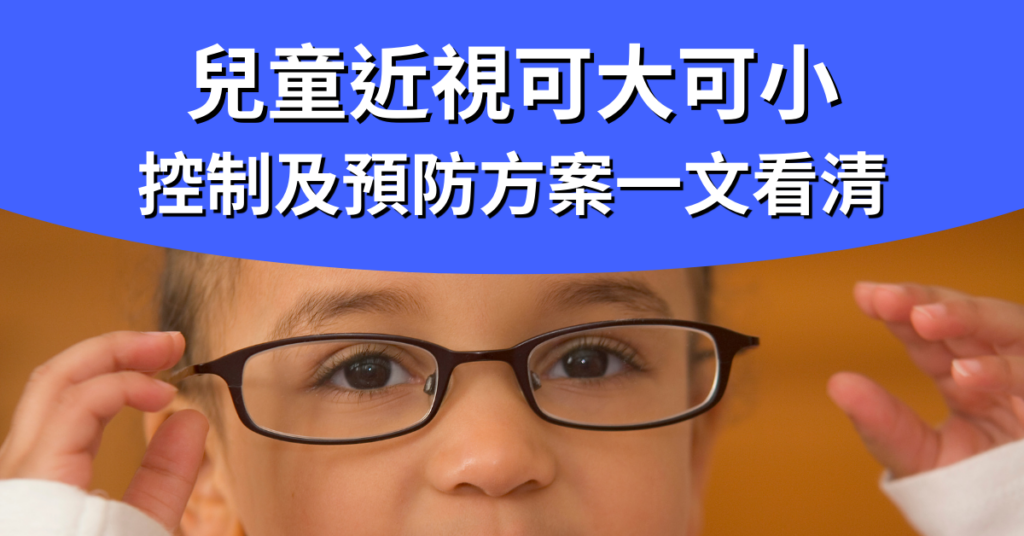
Shortsightedness is one of the most common eye problems among children today. According to the Health Department, approximately 18% out of 6-year-old children in Hong Kong have shortsightedness; the rate is even higher for 12-year-old children, reaching 62%, which is far higher than in other Eurasian regions. Aside from poor eye habits, if parents themselves have high levels of shortsightedness, the chances of their children developing shortsightedness will also increase significantly. Therefore, early prevention and control of children's shortsightedness progression is extremely important.
Electronic products are the main cause of children's myopia
With the widespread use of electronic products, the age group of children with myopia is also gradually increasing. Many parents treat electronic products as "baby pacifiers"; at a stage when children's eyes have not fully developed, they develop a habit of relying on electronic products, which affects the normal development of their eyes.
Among children with myopia, up to 80% of cases are caused by poor eye habits. Prolonged viewing of electronic screens causes the pupil to adapt continuously to changing light conditions, causing the ciliary muscle to remain in a constant state of tension to regulate the pupil size. This leads to excessive eye fatigue and increases the risk of myopia in children. To prevent or control the degree of myopia in children, parents must strictly control their children’s time spent using electronic devices while encouraging them to participate in outdoor activities and reduce their dependence on electronic pacifiers.
Is there a difference between children's myopia being real or not?
However, there is also “true myopia” and “pseudo-myopia”; the former is caused by changes in the eye structure that cannot be naturally restored; the latter is the temporary fatigue of the eyes; proper relaxation of the eye muscles can improve it. Since the recovery methods for both types of myopia are different, it is important to first understand which type of myopia the child has.
Pseudo-myopia often occurs in children under the age of 12 because the pupils of children under this age are very strong. In addition, due to prolonged use of electronic devices in close proximity, the pupils cannot relax naturally, leading to pseudo-myopia. However, as long as the eyes are given adequate rest, children with pseudo-myopia can regain normal vision.
If you suspect that your child has vision problems, it is recommended that you seek immediate medical advice from an ophthalmologist. Typically, pseudo-children's myopia can be corrected; most cases are treated by using eye drops to relax the eye, thereby detecting the true refractive state of the eye and determining whether it is true or false myopia.
Although childhood pseudo-myopia can be corrected, this is also a major sign of myopia; if the child does not correct their eye habits in time, it may eventually become true myopia.
How to detect that a child has myopia?
Young children may not realize they have vision problems, so parents should pay extra attention and observe their children to determine if they have myopia or other vision problems. If the following signs of myopia appear, parents should take their children to see an ophthalmologist:
- Frequently blinking or rubbing the eyes
- Frequently rubbing the corners of the eyes or squinting to see distant objects
- Frequently tilts their head to look at things
- When looking at things, the eyes and the object are very close together.
What are the consequences of neglecting to control children's myopia?
Some parents believe that if a child's myopia is not severe, it is not necessary to address it. However, in reality, if children's myopia is not controlled, the refractive index will gradually increase with age, and even rapidly increase within a short period of time. If the child already has myopia problems at a young age, it is easy to cause the refractive index to exceed 500 degrees.
But do you think that’s all it takes to make myopia worse? No! The deeper the myopia, the greater the risk of developing eye diseases such as cataracts, glaucoma, and macular degeneration in the future; in severe cases, it can even lead to blindness.
- Cataracts: The lens of people with high myopia tends to deteriorate and become cloudy, which increases the risk of developing cataracts.
- Cataract: People with high myopia have higher eye pressure, and the risk of developing cataracts is four times that of normal people.
- Macular degeneration: Among patients with myopia of up to 800 degrees and myopia of 10 years, approximately 5 to 10% patients have combined macular lesions.
- Floaters: The vitreous humor of highly nearsighted people is prone to degeneration, resulting in fibrous-like suspended matter.
- Retinal detachment: The retina of people with high myopia is prone to degeneration or atrophy, and the risk of developing retinal detachment is more than 20 times that of the general population.
Therefore, parents should actively monitor their children's near-sightedness and take control and preventive measures to prevent their children from becoming high-myopic in the future.
What are the methods for controlling children's myopia?
Generally speaking, the ideal rate of myopia progression for children should be no more than 50 degrees per year. If children's myopia increases by more than 100 degrees per year, it is considered an abnormal situation and may eventually develop into high myopia, which may also increase the risk of developing secondary complications. Therefore, in recent years, the medical community has been dedicated to researching various methods to control and improve myopia in children in order to slow down the progression of myopia in children.
Low-concentration atropine eye drops
Low-concentration atropine eye drops can inhibit excessive growth of the cornea and slow down the elongation of the eyeball, thereby controlling the deepening of children's myopia. Within 1 year, the deepening can be slowed down by 67%.
However, some children may experience side effects such as blurred vision after using low-concentration atropine eye drops, or difficulty seeing close objects; therefore, careful consideration should be given before using low-concentration atropine eye drops.
Corneal reshaping contact lenses (OK lenses)
Corneal reshaping contact lenses (OK lenses) are contact lenses worn at night for children with myopia of no more than 600 degrees. Their principle is to reshape the cornea through highly oxygen-permeable rigid lenses, allowing users to see clearly without wearing glasses during the day. Research has shown that long-term use of OK lenses can control the progression of myopia in children, generally slowing the rate of myopia progression to 50%–80%.
However, corneal reshaping contact lenses are only temporary vision correction; if they are stopped wearing, the degree of myopia in children will return to its original state.
Additionally, OK lens for controlling children's myopia usually costs between HK$5,000 and HK$10,000, plus the lenses need to be replaced every 9 months or so, so the price of these children's myopia control lenses may be somewhat expensive for some families.
Depth-of-field image stabilization (DIMS)
There are two types of distance vision lenses: the central portion is a normal near vision lens, and the surrounding portion is an optical element that utilizes the near vision distance effect to focus the surrounding image in front of the retina, thereby slowing down the eyeball elongation and controlling the speed of children's myopia. Research has confirmed that children who wear distance vision lenses experience a significant reduction in myopia over 2 years, reaching 52%.
Unfortunately, bifocal lenses are only suitable for children with myopia of no more than 650 degrees and astigmatism of no more than 400 degrees. Children with myopia exceeding this range must seek other control options. Moreover, the cost of these types of children’s myopia control lenses is not low either; currently, the price of commercially available children’s bifocal lenses starts at HK$4,000, which directly discourages parents who want to use lenses to control their children’s myopia.
An earlier method for controlling children's myopia—the Children's AI Myopia Control Program
As mentioned above, some eye drops used to control myopia in children can cause side effects. In addition, the prices of children’s contact lenses for controlling myopia on the market are currently too high, and with the so-called “prevention is better than cure,” parents are starting to realize that controlling their children’s myopia and the likelihood of their myopia deepening should not be started after they are diagnosed with myopia; rather, it should be started at an earlier stage to control the risk of myopia in children.
The Children's AI Myopia Control Program is a special project developed in Hong Kong in recent years. The prediction accuracy is as high as over 80%. The goal is to be able to predict the myopia development of children in the next 3 years in advance and customize individualized treatment plans in advance to control the progression or restoration of children's myopia.
The main process of the children's AI myopia control program is as follows:
- Fill out the questionnaire about the daily habits of your children
- Performing various eye examinations
- Importing inspection data and using AI and big data analysis to predict the myopia status of children for the next 3 years
- Parents and ophthalmologists can use reports and charts to understand whether the myopia development of their children is considered high-risk.
- Based on the evaluation results, ophthalmologists will customize personalized treatment for the child to slow down the progression of myopia in children and reduce the risk of high myopia.
Currently, Dr. Tong Wenjie, an ophthalmologist, is in charge of "Children's AI near-sighted control programIt has been validated in a sample of 129,242 adolescents, with a predictive accuracy of over 80%, helping to provide early warning of myopia in adolescents.
Parents can accurately predict their child’s future myopia changes through the “Child Myopia Control AI Smart Platform.” This AI platform uses big data intelligence to analyze the predicted results, allowing parents to observe the changes in their child’s refractive errors based on the predicted report (the parent can view this as a “refractive development file”). Ophthalmologists will also analyze the current myopia status of their child in detail based on the predicted report, comparing the normal refractive performance of the same age group with the general population, and formulating personalized myopia treatment plans.
Daily methods to improve or control children's myopia
To prevent or control myopia, in addition to seeking the help of an ophthalmologist, parents can also help children with myopia restore or improve their vision through daily life activities.
Establish correct eye-care habits
Whenever possible, children should maintain proper sitting posture when doing homework or reading. They should also avoid lying down or sleeping, and should also avoid reading or using mobile phones in dim light environments. Furthermore, children with myopia should control the time they spend using electronic devices each day and develop the habit of taking a 5-10 minute break every 30 minutes.
Eat eye-healthy foods
Parents can also provide their children with eye-healthy foods like vitamins A, C, E, lutein, and anthocyanins on a daily basis, which can help children with myopia recover or improve their vision.
Outdoor activities
Parents are advised to take their children outdoors daily for activities such as playing in playgrounds and going for walks in parks. This will reduce their time using electronic devices, and the sunlight outdoors can also stimulate the secretion of retinal dopamine, effectively controlling the progression of myopia in children.
The development of myopia in children is extremely rapid; even a slight lapse in attention can lead to a rapid increase in the refractive index. Therefore, in addition to supervising children to cultivate good eye habits in daily life, parents are advised to regularly have their children undergo eye examinations. Once abnormalities are detected, appropriate control measures and treatment plans can be implemented in time to ensure the healthy vision of children.