Presbyopia

Can an LBV laser correction treat both presbyopia and hyperopia at the same time?

Can an LBV laser correction treat both presbyopia and hyperopia at the same time?

Having worn glasses for decades, I now have to rely on glasses not only for distance vision but also for near vision. The prescription on the lens says "with presbyopia," and my glasses are getting more complicated. But my vision isn't clear enough. I want to undergo laser refractive surgery for presbyopia, but will having presbyopia affect the surgery? Does presbyopia need to be treated separately before I can undergo refractive surgery for presbyopia?

In fact, when designing the cutting plan, LBV can simultaneously calculate the scatter level, allowing the scatter and presbyopia to be corrected simultaneously during the same surgery. However, the degree, type, and shape of the cornea are key factors that determine whether the treatment can be performed at once.

What causes presbyopia? Why does it often occur along with cataracts?

Strabismus is caused by the cornea having an irregular surface that is more like an olive rather than a perfect circle, which prevents light from focusing on a single point when it enters the eye. This can result in blurred vision or double vision. Strabismus can occur alone or in combination with myopia and presbyopia in the same person.

As age progresses, the elasticity of the crystalline lens deteriorates, leading to presbyopia. At the same time, the shape of the cornea may also undergo slight changes due to prolonged wear, making the already slight astigmatism more noticeable. Therefore, having both presbyopia and cataracts after age 50 is very common; together, these conditions make lens fitting more difficult and the adaptation to progressive lenses more challenging.

Another fact that many people overlook is that the effect of chromatic aberration on vision varies significantly between bright and dim environments. When there is plenty of light during the day, the pupil is smaller, and chromatic aberration affects vision relatively slightly; at night or in dimly lit environments, the pupil enlarges, making it easier for chromatic aberration to cause heavy shadows or halos on the image. This is especially noticeable when looking at streetlights or car headlights. If you notice particularly poor night vision and see trailing lines or star-like patterns around the light source, chromatic aberration may be one of the causes.

Can LBV simultaneously correct farsightedness and presbyopia?

The LBV (Laser Blended Vision) surgical platform can integrate the refractive error into the correction plan when designing the double-eye cutting scheme. While correcting distance vision, the main eye simultaneously addresses refractive errors; while setting the near focus, the non-main eye also corrects refractive errors simultaneously. After the surgery is completed, the ideal situation is that both the refractive error and presbyopia are addressed, and daily life no longer requires the use of glasses.

The effectiveness of refractive correction depends on several factors: the degree of refractive error, whether the axial direction of the refractive error is regular, and the stability of the corneal shape. Generally speaking, regular refractive error (Regular Astigmatism) responds better to laser correction, while irregular refractive error (Irregular Astigmatism) requires more detailed pre-operative evaluation and may require addressing the corneal problem first in some cases.

💡 The effect of chromatic aberration on LBV

Mild to moderate refractive errors (usually 3.00D or below) can usually be corrected during an LBV procedure. Those with higher refractive errors or irregular corneal morphology require additional evaluation of the corneal topography to confirm that the surgical design can safely cover all refractive values.

💬 Book an eye assessment

There are both presbyopia and hyperopia. I would like to know if it is suitable to undergo LBV. Please feel free to contact us for more information.

WhatsApp inquiry

There are both presbyopia and hyperopia. What should I evaluate before the LBV procedure?

Preoperative evaluation is a necessary step to ensure that LBV can safely and effectively treat presbyopia and hyperopia. The evaluation usually includes:

Evaluation items Purpose
Corneal topography map Confirm whether the astigmatism is regular or irregular, and assess whether the corneal shape is stable.
Corneal thickness measurement Ensures the cornea has sufficient thickness to support the cutting amount required to correct presbyopia and farsightedness simultaneously.
Main visual acuity test Determine which eye is responsible for distance vision and which eye is responsible for near vision; develop an LBV dual-eye program
Radial axis verification Accurately record the direction of scatter light to ensure that the cutting design is aligned with the correct axis.

If the degree of astigmatism is high or the corneal topography shows irregular shapes, the doctor may recommend first stabilizing the cornea with other methods, or assess whether an alternative treatment method other than LBV is suitable, such as implanted contact lenses (ICL) or cataract surgery.

After LASIK and PRK, what changes does life bring about?

For individuals who wear both reading glasses, distance glasses, and bifocal glasses simultaneously on a long-term basis, the most immediate change after the LBV procedure is that they no longer need to frequently change their glasses. When driving, they can see clearly at a distance and the contrast improves; when reading, they no longer need to strain to see the phone or book clearly; and the nighttime glare or star-like light caused by presbyopia usually improves after the procedure.

For people aged 45 to 60 who are still working, such as those who spend long periods of time working with computers or documents, or who frequently need to switch between near and far vision environments, LBV can reduce visual fatigue and the hassle of changing glasses while correcting three problems (myopia, astigmatism, and presbyopia), and work efficiency may also improve as a result.

Common questions FAQ

Q1: Can LBV correct both my presbyopia and my farsightedness at once?

In most cases, it is possible. The LBV laser cutting design can integrate the correction of presbyopia and hyperopia, allowing both to be treated simultaneously during one surgery. However, whether correction can be achieved at one time and the effectiveness of the correction depend on the degree of presbyopia, the type of hyperopia, and the corneal thickness; this must be determined before the procedure.

Q2: What is the maximum dispersion number for an LBV?

Generally, regular astigmatism is approximately 3.00D or less, and in most cases it can be corrected with presbyopia. For those with higher astigmatism levels, it is necessary to assess whether the remaining corneal thickness is sufficient and whether the axial astigmatism is suitable for the laser cutting design. The specific upper limit varies depending on the individual corneal conditions; a pre-operative evaluation can provide a clear answer.

Q3: Is diffuse light regular or irregular? How do you know? What are the differences?

Regular irregular astigmatism occurs when the two main axes of the cornea are at 90 degrees perpendicular to each other; optical correction is more straightforward. Irregular irregular astigmatism is more complex in its corneal morphology and cannot be described in simple axial terms; it is common in patients who have undergone trauma or have a conical cornea. Regular irregular astigmatism usually provides a more ideal response to LBV laser correction; irregular irregular astigmatism requires more detailed evaluation.

Q4: After doing LBV, will the scattered light and presbyopia no longer be a problem?

LBV can effectively correct presbyopia and hyperopia during surgery. After correcting presbyopia, the degree of vision usually stabilizes because the corneal shape changes are permanent. As for hyperopia, since it is a persistent physiological phenomenon, the degree of vision may still slightly increase in the future. For some people, near vision may require mild reading glasses after a few years.

Q5: People with scattered light vision should undergo LBV. Is the recovery period after the procedure longer?

After refractive lens correction, visual quality usually shows significant improvement within a short period of time. The initial adaptation period for LBV itself requires the brain to adapt to the fusion of the two eyes; the adaptation period usually ranges from days to weeks. People with refractive lens errors do not necessarily have a longer adaptation period, but everyone’s adaptation progress is different; understanding the adaptation process before the procedure helps build reasonable expectations.

Q6: I have slight astigmatism; the optometrist said I don't need special correction; can I wear the LBV?

Mild astigmatism (such as 0.50D or below) usually has little impact on daily life. The LBV surgical plan can choose to correct it simultaneously or not specifically address it, depending on individual vision needs and corneal conditions. When discussing this with the doctor before the procedure, you can ask about the impact of correcting astigmatism on your overall vision.

Q7: Is diffuse light and presbyopia better when replacing the lens with an LBV?

Each has its own appropriate conditions. LBV involves laser cutting in the cornea; it is suitable for individuals with good corneal conditions and no cataracts; while multifocal refractive lens exchange is an eye surgery for those with presbyopia, cataracts, and early cataracts. The choice of which route to take requires evaluation and advice from a doctor based on individual eye conditions, age, and visual needs. For individuals with a higher degree of refractive error, the replacement lens option can sometimes be more effective in addressing all refractive problems at once, which should be considered when evaluating the options.

💬 Book an eye assessment

There are both presbyopic and hyperopic lenses. Would you like to know if the LBV is suitable for you? Please feel free to contact us for inquiries and reservations.

WhatsApp inquiry

Can an LBV laser correction treat both presbyopia and hyperopia at the same time? Read More »

I had laser surgery for nearsightedness, and now I'm experiencing farsightedness. Can I still have LBV?

I had laser surgery for nearsightedness, and now I'm experiencing farsightedness. Can I still have LBV?

Having undergone LASIK at the age of 30, I thought it would be a permanent solution to my problem of not needing glasses anymore. But after twenty years, squinting to read on my phone and borrowing a flashlight to read the restaurant menu have quietly arrived. The question I want to ask most is: “Has my cornea been reshaped already, and can I still undergo LBV laser refractive surgery?”

The answer is: Depending on the situation, it's not completely impossible, but a more detailed pre-operative evaluation is required. The cornea that has undergone laser refractive surgery has already undergone one cutting procedure; the key to a second procedure is whether the remaining thickness of the cornea is sufficient and whether the corneal shape is stable.

In fact, there are not a few people who have this question. Since laser refractive surgery became more widely available in Hong Kong in the 2000s, people in their 20s and 30s who underwent surgery back then are now in the 45 to 60 year age group with a high incidence of presbyopia. The "old surgery + new presbyopia" scenario is becoming increasingly common, and the answer is not a one-size-fits-all solution; it depends on the remaining corneal condition after the surgery you underwent back then.

Have you had laser vision correction for nearsightedness? What changes have occurred in the cornea?

Laser vision correction surgeries such as LASIK or SMILE involve cutting the corneal epithelium layer to change the curvature of the cornea, thereby correcting myopia. For every 100 degrees of myopia correction, approximately 10 to 15 micrometres of corneal tissue need to be cut, and the higher the degree of myopia, the larger the amount of cutting.

After surgery, the total thickness of the cornea is permanently reduced, but as long as the residual stromal bed remains at a safe level, the corneal structure is generally not affected. The problem is that if the patient wants to undergo another LBV in the future, whether this residual thickness is still sufficient to support a second incision needs to be re-measured and calculated.

LBV is the second laser surgery. Is it safe?

Having undergone refractive surgery for nearsightedness and then having LBV is essentially a second laser cornea surgery. In medical terms, this type of situation is called “enhancement surgery”; it is not uncommon to perform it after refractive surgery for nearsightedness; the key is whether the pre-operative evaluation is rigorous.

The primary criterion for evaluation is the remaining thickness of the cornea. Generally speaking, the remaining thickness of the corneal basement layer after surgery must be approximately 280 to 300 microns to provide sufficient space for a second incision. If the first surgery resulted in significant cutting, the remaining thickness is insufficient, then the LBV may not be a suitable option; the doctor may recommend alternative options such as implanted contact lenses (ICL) or replacement lenses.

💡 What are the differences between LASIK and SMILE after surgery?

After LASIK, the cornea retains a flap; in some cases, the LBV can be cut through by reopening the flap. The corneal cutting design is relatively flexible. After SMILE, there is no flap; this is a non-flap surgery. If further laser correction is required, it must be performed using different entry points; evaluation must be carried out with caution. Both cases require detailed pre-operative corneal measurements.

💬 Book an eye assessment

I have had laser vision correction for nearsightedness in the past, and I would like to know if LBV is feasible. Please feel free to contact us for more information.

WhatsApp inquiry

Preoperative evaluation: What data will the doctor look at when performing laser refractive surgery?

People who have previously undergone laser vision correction for myopia need to undergo a more detailed pre-operative evaluation when considering LBV. The evaluation focuses on the following:

Evaluation items Purpose
Corneal thickness (OCT / ultrasound measurement) Confirm whether the remaining substrate thickness is sufficient to support the second cutting process.
Corneal topography map Evaluate whether the corneal shape is stable after the first surgery and whether there are any irregular changes.
Valvular status (LASIK patients) Evaluate the integrity of the LASIK flap and confirm whether it can be safely reopened
Visual stability After the first surgery, the refractive error has stabilized and there has been no significant change.

It is worth noting that many people do not remember the year they underwent LASIK or SMILE surgery years later, nor do they remember the degree of correction they underwent. It is recommended that during the pre-appointment evaluation, try to collect records or doctor reports from the surgery to help the doctor more quickly grasp the history of the cornea. Even without documents, precise pre-surgery measurements can assess the current state of the cornea.

If the evaluation results show that the remaining corneal thickness is insufficient, or the corneal morphology is irregular, the LBV may not be the safest option. The doctor may recommend alternative options such as implantable contact lenses (ICL), cataract replacement, or wearing reading glasses. An unsatisfactory evaluation result is not necessarily bad news; it is a necessary step to ensure the safety of your eyes.

People who have had laser eye surgery now experience cataracts: how common is it?

Based on the prevalence of laser eye surgery in Hong Kong, a significant number of people enter the age group of presbyopia every year, while they themselves are beneficiaries of previous refractive surgery. For this group, there are several additional considerations when dealing with presbyopia: not only how to treat the presbyopia, but also whether the previous surgery has any impact on the new surgery.

The good news is that as long as the pre-operative evaluation confirms that the conditions are met, people who have undergone laser refractive surgery are not completely excluded from LBV. The bad news is that if the corneal thickness is insufficient, a different approach will need to be taken. Regardless of the outcome, clarifying your own eye condition is the first step towards making the right decision.

Common questions FAQ

Q1: I’ve had LASIK surgery and now want to have LBV. Is the cornea thick enough?

Whether a second LBV can be performed depends on whether the residual corneal thickness after the first LASIK surgery reaches a safe level (usually around 280 to 300 microns). This number varies from person to person and requires a corneal thickness measurement before surgery to determine it. If the initial surgery corrected a lower degree of vision, the residual thickness is usually more generous; those with higher degrees of vision require more careful evaluation.

Q2: Having had SMILE and LASIK, what are the differences between doing LBV again?

After LASIK, corneal flap remains; in some cases, LBV can be cut by reopening the corneal flap, a relatively straightforward procedure. After SMILE, there is no corneal flap; this is a non-flap procedure. If laser correction is to be performed again, the entry method differs and requires individual evaluation by the doctor. Both require precise pre-operative measurements to determine whether a second surgery is appropriate.

Q3: How long has it been since your last refractive surgery, and when can you undergo LBV?

It is generally recommended that after undergoing laser vision correction for the first time, visual acuity stabilizes for at least one to two years before considering a second surgery. If the visual acuity still changes slightly, a second correction is not recommended. During the evaluation, the doctor will review recent eye exam records to confirm that the visual acuity has sufficiently stabilized.

Q4: After undergoing near-sighted correction, is farsightedness coming faster?

Laser refractive surgery corrects nearsightedness, but it does not accelerate the development of presbyopia. Presbyopia is a result of the natural aging of the lens, and has no direct relationship to corneal surgery. It usually begins around the age of 40 to 45. People who have undergone refractive surgery sometimes experience more pronounced symptoms of presbyopia because they no longer need glasses for near vision after the procedure, but this is a perception of visual habit change rather than presbyopia actually coming earlier.

Q5: If the cornea is not thick enough to perform LBV, are there any other methods to treat cataracts?

If the remaining corneal thickness is insufficient to undergo LBV, there are several alternative options to consider: implanted contact lenses (ICL) with presbyopia correction, multifocal intraocular lens replacement (if appropriate for those with early cataracts), or wearing prescription progressive lenses. Each option has its own suitability criteria; doctors will recommend the most suitable option based on the individual eye condition.

Q6: After undergoing LBV, will the results of my previous LASIK procedure be affected?

The LBV involves additional cutting based on the initial surgery; the original near-sighted correction effect is not offset. The second cutting is designed on the cornea that has already corrected the nearsightedness, further adjusting the curvature to achieve the correction of farsightedness; the correction goals of the two surgeries do not conflict.

Q7: If I have undergone near-sighted correction surgery and then have LBV again, is the risk higher?

The risk assessment for the second laser surgery is more rigorous than for the first surgery. This is because it is necessary to ensure that the cornea remains safe after undergoing the initial procedure. As long as the pre-operative assessment confirms that the corneal conditions meet the requirements, the safety of the second surgery itself is based on rigorous evaluation. If the assessment indicates that the conditions are insufficient, the doctor will not recommend the surgery. In this case, choosing an alternative option is the more appropriate course of action.

💬 Book an eye assessment

I had laser vision correction for nearsightedness in the past, but now I am experiencing farsightedness. I would like to know if LBV is a viable option. Please feel free to contact us for inquiries and reservations.

WhatsApp inquiry

I had laser surgery for nearsightedness, and now I'm experiencing farsightedness. Can I still have LBV? Read More »

Can an LBV laser correction solve both myopia and hyperopia at the same time?

Can an LBV laser correction solve both myopia and hyperopia at the same time?

Mobile phone messages are easier to read when you look closer; looking up to see them clearly takes up too much energy; you have to replace the glasses with reading glasses. You alternate between wearing the near glasses and the reading glasses; when you take them off, you have to find another pair; many people aged 40 to 60 have the same problem. It is said that the LBV laser eye correction for presbyopia can correct presbyopia; but if you already have myopia, does that mean you can’t also wear both glasses? Does wearing both glasses after the procedure really mean you don’t have to wear both glasses?

In most cases, people with both myopia and hyperopia can be treated simultaneously with LBV (Laser Blended Vision). But “most” is the key: the myopia degree, corneal thickness, degree of hyperopia, and your expectations for post-operative vision are all important factors that determine whether LBV is suitable for you.

Myopia and Presbyopia: Two different problems that both trouble you

Myopia and farsightedness are two vision problems that are completely different mechanisms. Myopia is caused by the eyeball being too long, causing distant images to focus in front of the retina, making distant objects blurry. Farsightedness, on the other hand, is caused by the crystalline lens gradually becoming stiffer and losing elasticity with age, making it difficult to focus on close objects.

Traditional laser vision correction surgery (such as LASIK or SMILE) is used to correct myopia by cutting the cornea and changing the curvature; in doingi monovision, vision at the distance is clear after the procedure, but vision at intermediate distances is unclear.
No additional depth of focus is added
Color and contrast sensitivity may decrease
Reduced sense of three-dimensionality and distance perception

Although progressive lenses cover both near and far distances at the same time, they take a long time to adjust. Many people experience dizziness and distortion when looking at things from the side, making them particularly inconvenient in situations where frequent changes in distance are required. For people aged 50 to 65 who also have to commute to work, take care of grandchildren, or travel, the inconvenience caused by wearing glasses is often much greater than one might imagine.

How does LBV correct both nearsightedness and farsightedness at the same time?

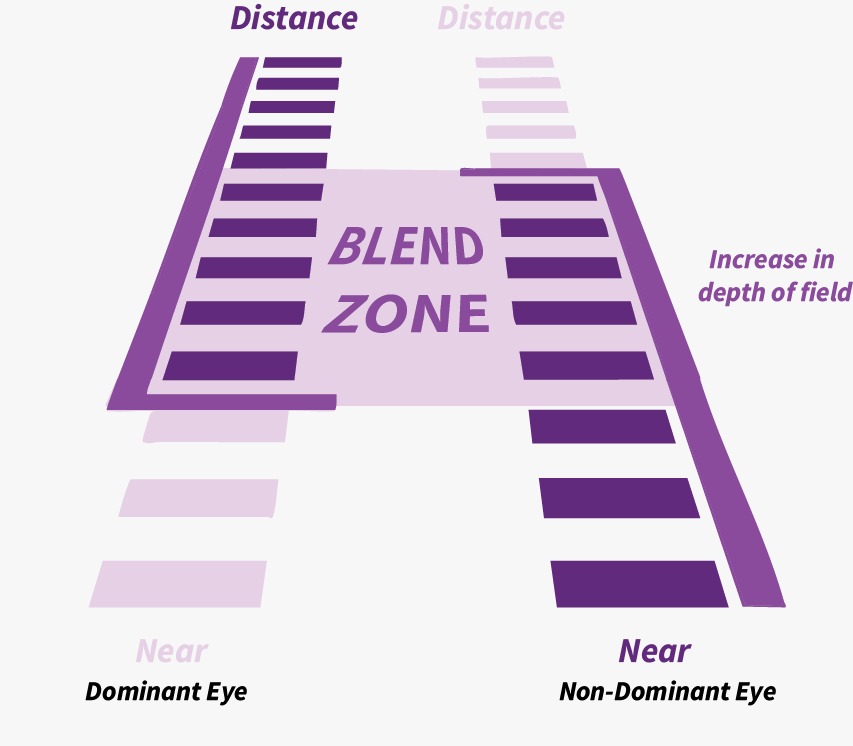
The core principle of LBV (Laser Blended Vision) is to utilize the division of labor between the two eyes to combine depth perception: the primary visual eye (usually the habitual eye) is primarily used to correct distance vision, while the non-primary visual eye corrects to a mild near focus, allowing you to clearly see text and objects at close range.

The biggest difference between LBV and traditional "monovision" is that both eyes retain a superimposed "blend zone," allowing the eyes to not be responsible for just one distance at a time but instead have a common mid-distance visual area. The brain can naturally fuse the images from both eyes, making the visual experience more natural and avoiding the imbalance that traditional monovision can easily cause.

If the patient already has myopia, the doctor can also take the myopia degree into account when designing the LBV program, so that both eyes can correct their respective farsighted and nearsighted focus while simultaneously eliminating the original myopia, achieving the effect of improving distance, near, and intermediate vision with a single surgery.

💬 Book an eye assessment

If you have myopia and hyperopia, is it suitable to undergo LBV? Please feel free to contact us for more information.

WhatsApp inquiry

What conditions need to be evaluated before performing LBV for people with both myopia and hyperopia?

Not everyone with presbyopia and hyperopia is a good candidate for LBV. The following factors are particularly critical during the pre-operative evaluation:

Evaluation factors Generally suitable conditions Special evaluation is required
Near-sightedness About 1000 degrees or below People with high myopia have a larger cutting amount; the remaining corneal thickness must be evaluated.
Corneal thickness Corneal thickness sufficient Those with thin corneas need to calculate the remaining thickness of the underlying tissue after surgery.
Degree of farsightedness Presbyopia range from 100 to 250 degrees Those with severe farsightedness will see limited improvement.
Eye coordination Good eye-hand coordination Patients with strabismus or amblyopia require individual evaluation.
Other eye health No blue light eye problems, no severe dry eye syndrome Any eye problems should be treated first.

Preoperative evaluation typically includes corneal topography, eye pressure measurements, fundus examinations, and tear fluid analysis to ensure the surgical design is precise and the cornea has sufficient thickness to support the amount of cutting. Some people may not be able to correct all the degrees of nearsightedness and farsightedness at the same time due to corneal conditions; the doctor will develop the most suitable plan based on the individual's situation.

💡 Brain adaptation period: A unique transition phase of LBV

After LBV, the brain needs time to learn to integrate images from the primary and non-primary visual fields. Most people adjust within a few days to a few weeks, with occasional minor visual instability during this period, especially at night or in low-light conditions. After the adaptation period, visual perception tends to become natural and smooth. This transition is a normal phenomenon; understanding it before the procedure helps reduce unnecessary anxiety.

What can I expect after LBV surgery?

After undergoing LBV and correcting nearsightedness and farsightedness at the same time, in most cases, daily life no longer requires the use of glasses, including for distance vision (driving, walking, watching TV) and near vision (reading, using a mobile phone, looking at restaurant menus). For those who wish to travel and take clear photos, play cards without having to frequently change glasses, and take their grandchildren out for outings without needing to frequently change glasses, the improvement in convenience in daily life is usually more noticeable.

What you need to know is that presbyopia is a physiological phenomenon that continuously deteriorates. LBV can only correct the degree of presbyopia at the time of surgery, but cannot prevent the progression of presbyopia in the future. Over the years, some people may need to wear mild glasses for near vision in the future, which is a normal process of eye aging and not a surgical problem.

Common questions FAQ

Q1: With both myopia and hyperopia, can the LBV really solve both problems at once?

In most cases, it is possible. When designing the cutting plan for LBV, near-sightedness and farsightedness can be taken into account simultaneously, allowing both eyes to correct their respective near and far focal points while simultaneously resolving near-sightedness. Post-operative vision is improved in both distance and near vision. The final ability to correct both problems at once depends on corneal thickness, near-sightedness, and farsightedness levels, which must be determined individually before surgery.

Q2: How is LBV different from traditional monovision?

Traditional monovision involves seeing things from one eye while focusing on the other, with each eye focusing on a different area. There is no common visual overlap between the two eyes; some people find it unnatural or experience problems with depth perception. LBV adds a blend zone to the depth of field, allowing the two eyes to overlap in mid-distance vision, making the brain’s integration of the images from both eyes more smooth and the adaptation period usually shorter. The daily visual experience is also more natural.

Q3: I have a near-sightedness of 600 degrees, can LBV correct it?

Near vision with a power of 600 degrees is generally within the range of consideration for LBV. Primarily, it is necessary to assess whether the corneal thickness is sufficient to support the required amount of ablation for both nearsightedness and farsightedness. Preoperative corneal topography and precision measurements can determine the actual correction range and the respective ablation design for both eyes.

Q4: Does the post-LBV visual acuity really not require the use of glasses?

In most cases, everyday near and far vision can be achieved to the extent that glasses are no longer necessary. However, "completely not wearing glasses" varies from person to person; some people may still need mild glasses in specific situations (such as fine reading or driving at night). Before the procedure, it is important to clearly communicate with the doctor about one's expectations for post-operative vision.

Q5: Will the farsightedness that develops after LBV surgery continue to worsen?

LBV can correct presbyopia during surgery, but it cannot prevent the progression of presbyopia as people age. Several years after the surgery, some people may need to wear mild reading glasses due to increased presbyopia, especially when reading for long periods of time. This is a normal physiological aging process.

Q6: How long should I stop wearing contact lenses before having LBV?

It is generally recommended to stop wearing soft contact lenses for at least one to two weeks before the procedure. Hard contact lenses require a longer period of discontinuation (usually four weeks or more). The reason is that contact lenses can affect the corneal shape; after discontinuation, the cornea returns to its natural state; the corneal topography measurement before the procedure can accurately reflect the true data. The specific time depends on the guidance of the primary physician.

Q7: With the LBV lens with multi-focus lens, which one should I choose?

LBV involves laser cutting in the cornea, is an external eye surgery, and does not require entry into the eye. Multi-focus intraocular lenses are implanted in the eye after removing the natural lens; this is an intraocular surgery. If the patient also has early cataracts, replacing the lens may be a more suitable step to take; if the corneal condition is good and there is no cataract, LBV is a less invasive option. Each has its own appropriate conditions; it is recommended to undergo a pre-operative evaluation by a doctor based on the individual eye condition.

💬 Book an eye assessment

If you want to know if nearsightedness and farsightedness are suitable for LBV, please feel free to contact us for inquiries and reservations.

WhatsApp inquiry

Can an LBV laser correction solve both myopia and hyperopia at the same time? Read More »

Understanding the risks and precautions of laser vision correction for presbyopia

1. 引言

隨著年齡的增長,人體會出現各種生理變化,其中視力的變化尤為顯著。老花眼是一種常見的自然生理現象,通常在四十多歲開始出現,顯著影響人們的日常生活。為了改善視力問題,越來越多的人選擇老花激光矯視手術。本文將深入探討這種手術的相關技術、費用、風險及注意事項,幫助大家更好地了解老花激光矯視。

2. 甚麼是老花激光矯視?

老花眼是由於眼晶體的彈性減少,使得近距離視力逐漸下降。老花激光矯視是利用激光技術調整角膜形狀,促使眼睛在不同距離的物體上獲得清晰的視覺。這種手術有助於減少或消除對老花眼鏡的依賴。

3. 老花激光矯視的治療技術

老花激光矯視的主要技術包括:

3.1 PresbyMAX老花矯視技術

PresbyMAX技術是一種針對老花眼的激光治療方法,與傳統的LASIK手術原理相似。此技術透過創建角膜瓣並進行激光處理,以形成多焦點的角膜形狀,幫助患者在不同距離的物體上都能獲得清晰的視力。

3.2 微笑矯視(SMILE)

SMILE技術是一種相對較新的激光矯視手術,它透過比傳統LASIK更小的切口來進行操作。這種技術具更小的手術傷口和較短的恢復時間,同時減少對眼睛神經的損傷,從而降低術後眼乾等後遺症的風險。

4. 老花激光矯視的後遺症與風險

4.1 常見的激光矯視後遺症

儘管老花激光矯視手術的成功率很高,但仍然存在一些風險和後遺症,包括:

  • 術後短暫視力模糊
  • Dry eyes
  • 短暫光暈或眩光現象

4.2 如何減少老花矯視的風險

減少手術風險的幾個指導原則包括:

  • 在手術前與醫生詳細討論病史及職業需求
  • 術後定期追蹤檢查,及早發現問題

5. 建議事項

醫生建議患者在選擇激光矯視手術前,應評估自身的健康狀況及視力問題,明白手術的風險和收益。如果有高眼壓或其他眼部疾病,則需謹慎考慮是否適合進行該手術。

6. 結論與未來展望

老花激光矯視手術雖然可以顯著改善視力及生活質量,但患者在決定是否進行該手術時,必須充分了解所有相關風險及後遺症,並選擇適合的技術與醫療機構。隨著技術的進步,未來可望出現更加安全、有效的治療方案,幫助更多人擺脫老花眼的困擾。

FAQ

  1. 老花激光矯視的手術效果能持續多久?

大多數患者在手術後可以享有長期的視力改善,但隨著年齡的增長,可能仍需佩戴老花眼鏡進行輔助。

2.激光矯視手術風險大嗎?

激光矯視手術的風險相對較低,而風險主要來自於個人眼睛的特點及手術後的護理。充分的術前檢查及選擇經驗豐富的醫生有助於降低風險。

Understanding the risks and precautions of laser vision correction for presbyopia Read More »

5種老花眼矯視方法_封面圖

How to correct presbyopia? An ophthalmologist explains 5 major methods of correcting presbyopia!

PresbyopiaPresbyopia is a vision problem that occurs with age. Almost everyone develops presbyopia; it usually occurs in people around 40 years old. Many people with presbyopia are reluctant to wear reading glasses because they fear being ridiculed for being old, which can affect their daily lives. However, there are now more and more methods to correct presbyopia available on the market; wearing reading glasses is no longer the only option; Dr. Tong Wenjie, an ophthalmologist who strongly recommends it, is one of them. Presbymax cataract laser surgeryThis not only avoids the embarrassment of wearing reading glasses, but also allows the eyes to regain the vision of their younger days.

Methods of treating presbyopia

Although cataracts are not considered a serious eye disease,PresbyopiaAs people age, this gradually affects their standard of living, so many people consider undergoing cataract surgery to correct their vision.

LBV progressive lens correction

Laser Blended Vision, or LBV multifocal correction, is a form of multifocal correction that uses laser to correct the shape of the cornea.Improve farsightednessOne of its methods. Its operation principle is to change the curvature of the cornea to adjust the refraction of light, while improving presbyopia, it also provides better three-dimensional vision and ensures good vision at long and intermediate distances.

However, LBV multifocal contact lenses are not suitable for everyone; for example, patients with eye diseases such as cone-shaped cornea, cataracts, or glaucoma may not be able to undergo this type of surgery.

SMILE progressive lens correction

Smile old-fashioned reading glassesThe system using a femtosecond laser (Carl Zeiss VisuMax) focuses the main lens into a flat image without any degree of distortion (for viewing distances at medium and long distances), while the secondary lens is designed to focus at approximately 50–200 degrees (for viewing at close distances), thereby improving the problem of presbyopia.

The biggest advantage of Smile multifocal contact lenses is that they do not require the complete opening of the corneal flap during the process of correction; only about 3 mm of incision is required to remove the excised tissue, thus offering high safety and a short recovery time, and less dry eye after surgery.

However, this type of surgery is not suitable for people withFar visionPeople with myopia greater than 1000 degrees or presbyopia greater than 500 degrees. Moreover, the Monovision "one-eye vision" principle of SMILE multifocal contact lenses may cause blurred mid-distance vision and lead to problems with poor stereopsis.

Presbymax Presbyopia correction

Presbymax cataract surgery is currently one of the methods globally recognized as effective in improving presbyopia. Doctors use laser to refine the cornea, creating a convex lens effect that improves the vision problems of presbyopia. This surgery also incorporates Spherical Aberration, which reduces slight spherical aberration, increases the depth of field, elongates the focal point, and changes chromatic aberration. This not only makes distant, intermediate, and near vision clear, but also prevents distortion of original colors and the sense of depth, and does not cause glare.

Presbymax multifocal contact lenses are the most advanced and mature in modern times.Laser vision correction treatment for presbyopiaThe patient satisfaction rate is very high; compared to LBV and SMILE, Presbymax is more suitable for most patients with presbyopia.

Presbyopia surgery

Single-eye vision surgery

Single-eye vision surgery is performed by laser refractive surgery to correct farsightedness. The principle is to correct the main eye to 0 degrees, while the other eye retains the near-vision correction to compensate for farsightedness. This type of surgery is suitable for those with myopia and those without it.CataractSomeone from

However, since the visual acuity of both eyes after surgery will vary significantly, it takes some time for the eyes to adjust; some people may not be able to adapt to this change and will need to consider undergoing another surgery. Additionally, post-surgery cataracts can also have the potential to worsen again, which may mean that they will need to wear reading glasses again in the future.

Multifocal artificial lens

Multifocal intraocular lenses are implanted "glasses" that offer full-field vision in all distances—far, intermediate, and near.Artificial lensIt can simultaneously improve problems such as presbyopia, myopia, or hyperopia. If a patient with presbyopia also suffers from cataracts, they can consider undergoing this type of surgery. The cataract problem can be solved simultaneously. Multifocal intraocular lenses are made of elastic materials such as plastic or silicone, and usually are not noticeable. However, this type of surgery is invasive; after the procedure, care must be taken to avoid problems such as bacterial infection or lens dislocation.

How to choose cataract surgery?

Advanced cataract surgery continues to innovate, leading to a wide range of methods for correcting cataracts today. However, not all surgeries are suitable for everyone. Therefore, when choosing cataract surgery, it is necessary to carefully consider multiple factors, such as a patient’s medical history, the degree of nearsightedness/far-sightedness/astigmatism, personal lifestyle habits, and cataract surgery costs. To achieve optimal treatment results, doctors generally perform comprehensive examinations on patients before the procedure to confirm their eye health status before deciding on the treatment method.

Dr. Tung Weijie stated that Presbymax cataract surgery is one of the currently recognized and mature cataract surgery methods worldwide. The patient satisfaction rate after the Presbymax surgery is extremely high, and in Hong Kong, the cataract surgery costs are relatively affordable. The surgery takes only a very short time, about 10 minutes, and patients can resume normal activities within 24 hours. Vision can be fully restored within a few weeks without any discomfort, making Presbymax the best choice for cataract surgery.

Risk of presbyopia correction

Presbyopia correction surgery is usually classified as a minimally invasive procedure. The incision is small and recovery time is relatively short. However, in reality, all surgeries carry some risk. Therefore, before considering undergoing surgery, it is still necessary to learn about some of the risks associated with presbyopia correction in advance.

  • Infection of the wound:After the procedure, it is essential to take care of the wound according to the doctor's instructions to prevent bacterial infection.
  • Glare and shadows:Some old-lens vision correction procedures may cause glare or ghosting after the procedure, which may affect nighttime driving.
  • Fear of lightSome patients may be more sensitive to light after surgery, which can lead to discomfort in bright environments.
  • Excessive or insufficient correction:Although doctors meticulously formulate corrective treatment plans before surgery, it is not possible to guarantee 100% accuracy; if the patient experiences discomfort, a second surgery may be necessary to improve the situation.
  • Corneal problems: In rare cases, surgery may lead to corneal problems such as scarring or corneal epithelial cell proliferation.

The risk of farsighted eye surgery may vary depending on the procedure. It is recommended that you ask your doctor for a detailed explanation before choosing farsighted eye surgery. Of course, these risks do not occur frequently and may be temporary. As long as you seek the help of a qualified ophthalmologist, there is no need to worry excessively.

How to correct presbyopia? An ophthalmologist explains 5 major methods of correcting presbyopia! Read More »

5種改善老花眼的方法_封面圖

5 Ways to Improve Presbyopia

PresbyopiaIt is a vision problem related to age. When people reach around 40 years old, they start to find it difficult to focus on near objects and need to move the objects farther away from their eyes to see clearly.

So, can farsightedness be improved? How can farsightedness be improved? First of all, farsightedness is a vision problem that not everyone can avoid; the eye structure naturally ages as we reach a certain age, resulting in a decrease in vision. However, with advances in medicine, there are now many methods available to effectively correct farsightedness.

Next, this article will delve into five methods to improve farsightedness, helping you to improve your farsightedness.

Wearing reading glasses

Wearing reading glasses is one of the most common ways to improve presbyopia. There are currently two options available: single-focus lenses and progressive lenses. Single-focus lenses allow you to see objects at a fixed distance; they are only worn when you need to see things that are close up. Progressive lenses allow you to see objects at long, intermediate, and close distances at the same time. Although progressive reading glasses may seem convenient, their design is somewhat special, so for some people they may cause dizziness due to discomfort.

If traditional reading glasses are inconvenient for you, or you find them unsuitable for wearing due to work-related reasons, you can also consider wearing reading glasses with bifocal lenses. The specific choice of reading glasses or bifocal lenses depends on your personal lifestyle and adaptability; you can also seek advice from an ophthalmologist.

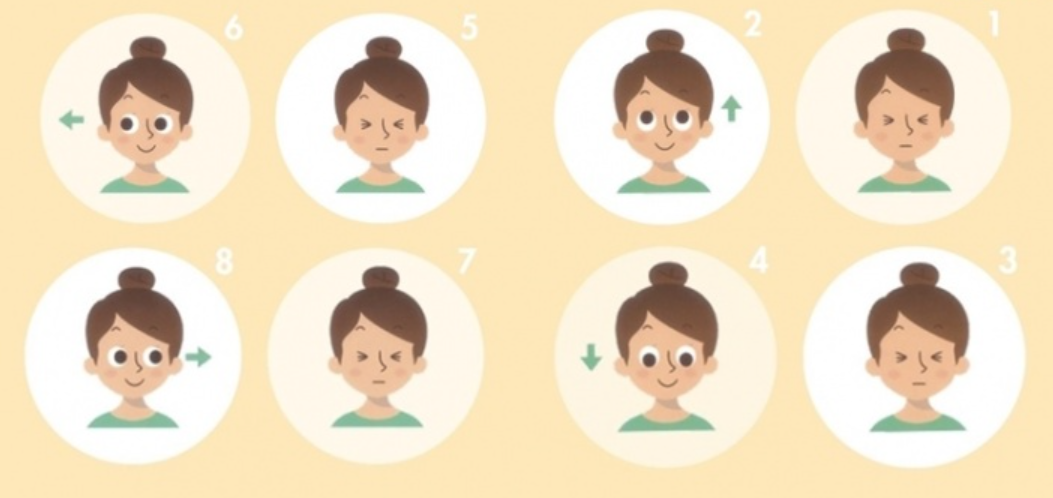
Performing eye movements

Proper eye exercises not only improve farsightedness but also effectively prevent farsightedness and other eye diseases. There is no specific time frame for eye exercises; simply doing them every day will have an effect.

Quick blink movement

The blink reflex stretches the eyelid muscles, restoring the elasticity of the eye muscles, and effectively promotes blood circulation.

  1. Close your eyes for 2 seconds, then open them and look at the object for 5 to 10 seconds.
  2. Close your eyes for 2 seconds, then open them and look down for 5 to 10 seconds.
  3. Close your eyes for 2 seconds, then open them and look to the left for 5 to 10 seconds.
  4. Close your eyes for 2 seconds, then open them and look to the right for 5 to 10 seconds.

Eye focusing movement

Extend your thumb, focus your eyes on the thumb, and slowly move your thumb closer to your eyes, then move it farther away from your eyes. Repeat this process repeatedly to effectively train the ciliary muscle and improve farsightedness.

Maintain good lifestyle habits

Good eye care habits are one of the important ways to improve and prevent presbyopia. When using electronic devices, avoid using fonts that are too small to prevent prolonged squinting that causes the crystalline lens and ciliary muscle to age prematurely. Additionally, try to rest your eyes for 5 to 10 minutes every hour by closing them or looking at a distant object to give your eyes a proper rest to relieve eye strain.

In addition, due toPresbyopiaAs the age increases, it becomes more and more difficult to see clearly, so it is recommended to undergo 1-2 eye examinations a year and to improve farsightedness using the methods provided by the ophthalmologist.

Eat eye-healthy foods

In addition to the above methods to improve farsightedness, we can also eat more eye-healthy foods on a daily basis to improve or prevent the symptoms of farsightedness. It is recommended that we pay more attention to supplementing the following nutrients on a daily basis to maintain eye health:

Omega-3 fatty acids

It can be obtained from fish such as salmon and sardines.

Flavonoids

Beta-carotene is an essential nutrient for eye health that can be obtained from foods such as chicken eggs and spinach.

Vitamins A, C, and E

Vitamins A, C, and E contain abundant antioxidants that can effectively slow down the progression of cataracts, thereby improving cataracts. These nutrients can be obtained from fruits such as mangoes, apricots, and avocados, among others.

In addition to the above nutrients, zeaxanthin, lutein, and beta-carotene also have eye-healthy effects; you can also seek advice from an ophthalmologist or nutritionist regarding eye-healthy foods.

Having refractive surgery performed

For those who want to quickly solve the problem of farsightedness, refractive surgery may be an ideal choice. The following will introduce several common procedures.Presbyopia correction surgery:

Cataract surgery

If the elderly person suffers from cataracts, cataract surgery is also a method that can simultaneously improve farsightedness. How does cataract surgery improve farsightedness? Before starting cataract surgery, the patient can choose the appropriate lens with the help of a doctor.Artificial lensInserted into the eye. However, it is important to note that after implantation of the artificial lens, side effects such as halos, glare, and lower contrast sensitivity may occur. Therefore, doctors generally recommend that patients try wearing contact lenses before the surgery to test visual correction.

LBV progressive lens correction

Laser Blended Vision, or LBV multifocal refractive surgery, is one method of correcting presbyopia by correcting the shape of the cornea through laser treatment. Its operating principle involves changing the curvature of the cornea to adjust the refraction of light, thereby improving visual problems. However, LBV multifocal refractive surgery is not suitable for everyone; for example, patients with eye diseases such as cone-shaped corneas, cataracts, or glaucoma may not be able to undergo this type of surgery.

SMILE Presbyopia correction

Small Incision Lenticule Extraction (SMILE) cataract surgery uses the Carl Zeiss VisuMax femtosecond laser system to flatten the main eye into a flat, uncorrected vision without any refractive error. The main eye is preserved with approximately 50-200 diopters of myopia to compensate for presbyopia. SMILE cataract surgery can be performed without opening the cornea, by making a small incision of approximately 3 millimeters to cut out the corrected corneal tissue, thereby changing the corneal curvature to correct presbyopia. However, SMILE cataract surgery also has certain limitations, such as that it may not be suitable for people with high farsightedness or near-sightedness.

Presbymax Presbyopia correction

Presbymax multifocal lens correction is currently one of the methods globally recognized as effective for improving presbyopia. By applying laser to the surface of the cornea to form a convex lens effect, this procedure improves the vision problems of presbyopia. This surgery also incorporates Spherical Aberration, which is a slight spherical aberration that increases the depth of field of both eyes, elongates the focal point, and changes chromatic aberration, which not only makes distant, intermediate, and near vision clear, but also does not affect the original color and sharpness of depth perception, nor does it cause glare problems. Presbymax multifocal lens correction is the most advanced and mature method in modern ophthalmology.Laser vision correction treatment for presbyopiaThe patient satisfaction rate is very high; compared to LBV and SMILE, Presbymax is more suitable for most presbyopic patients.

In short, improving farsightedness is not difficult; it can be achieved through proper methods. For more information, please click the button below to contact our ophthalmologist and develop a suitable plan for your individual situation.

5 Ways to Improve Presbyopia Read More »

近視和老花分別_封面圖

What should I do if I have both nearsightedness and farsightedness? Read this article to learn about refractive eye surgery methods.

Myopia andPresbyopiaThese are two different vision problems, but they can indeed coexist in the same person. These common vision problems can affect quality of life and work efficiency, so it is important to identify them early and actively seek appropriate vision correction solutions. The following will help you distinguish between nearsightedness and farsightedness, and how to correct nearsightedness + farsightedness.

What is presbyopia?

Presbyopia is a part of the natural aging process of the eyes; it usually occurs after age 40 and mainly manifests as blurred near vision. As age increases,The degree of old flowersThis gradual increase is due to the crystalline lens of the eye losing its elasticity and weakening its refractive power, making it difficult for the eye to focus on objects at close range, especially in darker environments.

Although the incidence of farsightedness is related to age, with the advancement of technology, almost everyone is surrounded by electronic devices. Long hours of staring at screens lead to prolonged strain on the ciliary muscles, prematurely aging the eyes. In Hong Kong, the incidence of farsightedness among people under 40 has increased by 20 to 30 percent; many people even begin experiencing symptoms of farsightedness between the ages of 35 and 40.

What is myopia?

Unlike nearsightedness and farsightedness, nearsightedness refers to the ability to see clearly when looking at objects at close range, but seeing distant objects becomes blurry. Nearsightedness is usually caused by the cornea of the eye or the length of the eye not matching its refractive power, resulting in the light not being properly focused on the retina.

The causes of myopia are mainly two: hereditary and acquired. However, myopia is mainly caused by acquired factors, such as prolonged near-distance reading or using electronic devices, or using the eyes in overly bright or dark environments. In contrast, the risk of hereditary myopia is relatively low, unless both parents are severely nearsighted.

How to distinguish between farsightedness and nearsightedness?

Presbyopia and myopia are two different vision problems. Presbyopia is the inability to see clearly at close distances; myopia, on the other hand, is the feeling of blurred vision when looking at objects at long distances.

The following chart provides a simple overview of the signs, causes, prevention, and treatment methods for farsightedness and nearsightedness.

PresbyopiaMyopia
SymptomsClose-up images are blurry and difficult to read.The long-distance image is blurry and the road signs are not clearly visible.
CausesAging of the ciliary muscle and stiffness of the corneaExcessive eyeball protrusion
Prevention methodsAvoid excessive eye strain. Eat a healthy diet. Regular eye examinations after age 40* Cataracts cannot be avoided; only the rate of progression can be slowed down.Reading under good lighting helps prevent long-term use of electronic devices and regular eye examinations.
Treatment methodsPresbyopia glasses and contact lensesPresbyopia correction surgeryMyopia glasses and contact lens surgery

Can people with nearsightedness also develop farsightedness?

Yes, even with myopia, it is possible to develop presbyopia in middle age or old age. People with myopia can initially see clearly with their near vision glasses, but after age 40, they may find that they cannot see clearly when looking at near objects, and even need to remove their near vision glasses to see clearly. In this case, they need to replace their glasses with ones that have presbyopia functionality.

How to treat farsightedness and myopia?

Progressive glasses

Wearing glasses is one of the most common and affordable treatment methods. If you also suffer from nearsightedness and farsightedness, you can consider choosing progressive lenses. Progressive lenses can place the degrees of nearsightedness and farsightedness on the same lens, eliminating the hassle of having to frequently replace your farsighted and nearsighted glasses. Using progressive lenses makes it more convenient to meet visual needs at different distances, making it the vision correction option most people will prioritize.

Contact lenses

Today’s contact lenses are not limited to a single function; there are also some that can correct both nearsightedness, farsightedness, and presbyopia at the same time. For those who do not like wearing glasses, you can consider choosing contact lenses that correct both farsightedness, presbyopia, and myopia at the same time. However, if you want to purchase contact lenses that can simultaneously improve near vision, farsightedness, and presbyopia, you need to seek professional eye care to have it fitted by an ophthalmologist after a series of examinations and evaluations to ensure the visual correction is effective and comfortable.

Orthopedic surgery

For some people, refractive surgery may be the best solution for quickly correcting nearsightedness and farsightedness. These surgeries can improve vision by changing the structure of the eye. If you plan to restore your vision through refractive surgery, you must seek out a qualified and professional ophthalmologist for the procedure.

It is important to note that although surgery can solve the problems of nearsightedness and farsightedness, the degree of farsightedness will still increase year by year as one ages. Therefore, before considering surgery, it is advisable to seek advice from an ophthalmologist and thoroughly understand the risks and effects of the procedure. At the same time, patients should be prepared and aware that they may need to re-wear reading glasses or contact lenses after the surgery.

#Presbyopia, myopia, # #presbyopia, myopia, #presbyopia at the same time, presbyopia with age-related myopia

What should I do if I have both nearsightedness and farsightedness? Read this article to learn about refractive eye surgery methods. Read More »

遠視和老花_封面圖

What are the differences between farsightedness and presbyopia? Explaining the causes and treatment methods in detail

Both farsightedness and nearsightedness are conditions where the visual field is clear when looking at objects at a distance, but blurred when looking at objects at close range. Therefore, people often confuse farsightedness and nearsightedness. However, farsightedness and nearsightedness are two completely different vision problems, and the corrective methods for each are also slightly different. The following will help you distinguish between farsightedness and nearsightedness, and how to correct farsightedness and nearsightedness.

What is presbyopia?

PresbyopiaIt is a vision problem related to age. When people reach around 40 years old, the eye's lens gradually loses elasticity, making it difficult to see objects at close range, especially when reading small fonts or performing close-up work. Moreover, constant eye strain often leads to blurred vision.HeadacheSymptoms such as eye pain and so on.

Presbyopia is a vision problem that cannot be avoided by anyone. Assuming you do not have myopia, hyperopia, or other vision problems, most people will start to develop presbyopia around the age of 40, with the degree increasing by an average of 10 degrees each year thereafter; after 60 years of age, the degree gradually decreases.


The following list of old-lens prescriptions is only a general reference; the old-lens prescription is generally measured in British letters “D” (Diopter), for example, +1.00D means the old-lens prescription is 100 degrees.

Age and presbyopia chart
AgePresbyopia
40 years old+1.00D
50 years old+2.00D
60 years old+3.00D
After 60 years of ageGradual decline in numbers

What is farsightedness?

Far-sightedness is a vision problem related to the structure of the eyeball. Generally, farsightedness is congenital. If one of the parents has farsightedness, the child is also highly likely to develop the problem.

The main causes of farsightedness are due to the eyeball having an excessively short axial length or a cornea with poor curvature, which causes the focus to be behind the retina instead of directly focusing the object on the retina. Similar to cataracts, people with farsightedness can see clearly distant objects, but when looking at objects at close range they may experience blurred vision and, over time, headaches or eye strain may occur when using the eyes for long periods of time.

How to distinguish between farsightedness and presbyopia?

Symptoms of farsightedness and presbyopia appear similar, but they are actually two different vision problems. Presbyopia is caused by the eyeball being shorter than normal, which means that objects cannot focus on the retina; farsightedness is a vision problem associated with age, mainly due to the deterioration of the ciliary muscles and the lens, which makes focusing difficult.

The following chart provides a simple overview of the symptoms, causes, prevention, and treatment methods for farsightedness and nearsightedness.

PresbyopiaFar vision
SymptomsClose-up images are blurryClose-up images are blurry
CausesAging of the ciliary muscle and stiffness of the corneaThe eyeball axis is short and the cornea has a flat arc.
High-risk groupsAge 40 and aboveFamily inheritance
Prevention methods*Presbyopia cannot be avoided; it can only be slowed down.
Avoid excessive eye strain and eat a healthy diet: Regular eye examinations after age 40
*Far-sightedness is hereditary and can only be slowed down by reducing the degree of nearsightedness.
Regular eye examinations and early vision correction
Treatment methodsPresbyopia glasses and contact lensesPresbyopia correction surgeryEyeglasses and contact lens correction surgery

Can you still develop farsightedness and cataracts?

This is because presbyopia is related to age; no one can avoid it. However, people with farsightedness tend to develop presbyopia earlier than those with myopia, because the degree of farsightedness and myopia cannot be offset. Additionally, if farsighted patients do not undergo timely correction, the ciliary muscle may age prematurely due to prolonged overuse. Therefore, even if they have myopia, the symptoms of farsightedness will still appear as they age.

How to treat farsightedness and presbyopia

As medical technology continues to develop, correcting farsightedness and presbyopia is no longer limited to wearing traditional eyeglasses; whether through surgery or wearing contact lenses, customized vision correction can be achieved, while improving farsightedness and presbyopia problems.

Presbyopic glasses

Wearing reading glasses is one of the most common ways to improve presbyopia. Prescription-matched reading glasses can provide clear vision at close distances, helping patients overcome difficulties when reading and working close up. However, some people choose to purchase reading glasses on their own and casually wear them on the street. Over time, this can actually damage the glasses. Therefore, it is always wise to seek professional eye care to have your presbyopia-appropriate reading glasses fitted.

For people who already have presbyopia issues, they may need to wear additional reading glasses and need to change glasses in different situations. This can cause some inconvenience, at which point choosing multifocal lenses to address both presbyopia and myopia at the same time becomes a consideration.

Old-fashioned con

Although it is a progressive lens, its design principle and traditional multifocal lenses are similar, so today’s progressive lenses are no longer focused solely on improving presbyopia; they can also improve farsightedness and other vision problems. Typically, these types of progressive lenses require professional eye care to be fitted by an ophthalmologist; not everyone is suitable to wear contact lenses, so a checkup of the eyes is necessary before fitting.

Presbyopia correction surgery

Modern cataract surgery is a fundamental solution to the problems of farsightedness and presbyopia, allowing patients to no longer rely on reading glasses or contact lenses. Especially the latest technologyPresbymax cataract correction technologyIt can simultaneously correct farsightedness, allowing patients to have clear vision and no longer be bothered by presbyopia and farsightedness.

The biggest advantage of Presbymax is that it can achieve full 3D vision across all distances. Whether there is presbyopia, myopia or hyperopia, Presbymax cataract surgery can perfectly solve these vision problems. Additionally, this type of surgery is short in duration and has minimal scarring. Most patients can resume their daily activities within 24 hours, with extremely high success rates.

For those who do not want to wear traditional glasses or are not suitable for wearing reading glasses, Presbymax cataract surgery is arguably the best value for money option.

What are the differences between farsightedness and presbyopia? Explaining the causes and treatment methods in detail Read More »

老花和散光_封面圖

Are farsightedness and presbyopia really indistinguishable? Read this article to get a clear understanding.

隨著年齡的增長,許多人可能會開始發現看事物變得模糊,閲讀變得困難,這種情況通常稱爲老花。然而,罹患散光眼的患者在看事物時同樣也會遇到視力模糊的問題,因此,很多人常常混淆老花和散光。這兩者該如何區別?老花和散光同時出現的話又該如何處理?下文將一一為你解釋。

What is presbyopia?

Presbyopia是一種隨著年齡增長而發生的視力問題。老花主要影響到人們對近距離物體的清晰度,尤其是在閱讀小字或執行細微工作時。

老花發生的主要Causes是因爲眼睛中的晶狀體變得僵硬,使其難以調整焦距以看清近距離的物體。這種變化是由於眼睛組織的老化,導致晶狀體失去彈性和靈活性。老花通常在40歲左右開始出現,並會隨著年齡的增長而加劇,直到60歲後度數的上升趨勢才會逐漸減慢。

什麼是散光?

散光是一種屈光不正的現象,可分爲先天性和後天造成,無論是哪種散光,其主要症狀都是看事物時會出現曡影影像模糊或扭曲的情況。

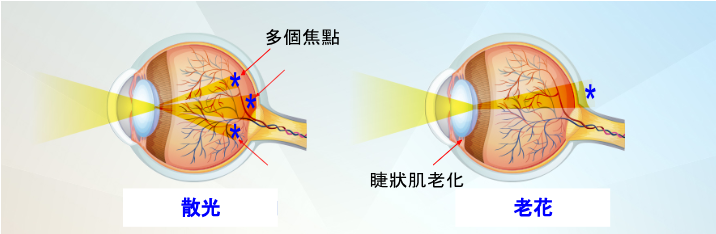
在正常的情況底下,光線會通過角膜、水晶體和玻璃體後,在視網膜上聚為一個焦點,形成清晰的影像。如果角膜的弧度不規則的話(即,角膜不是呈正圓的半球體),光線就無法正常通過,形成多焦點的現象。

老花和散光的分别

老花和散光是兩種不同的視力問題。散光是指光線聚焦不同,導致遠近距離畫面出現模糊或扭曲;而老花則是因爲眼球結構老化造成近距離視力喪失。

以下圖表簡單概括老花和散光的徵狀、成因、如何預防和治療方法。

PresbyopiaChromatic aberration
SymptomsClose-up images are blurry and difficult to read.遠近事物有曡影影像扭曲
CausesAging of the ciliary muscle and stiffness of the cornea角膜弧度不規則
Prevention methodsAvoid excessive eye strain. Eat a healthy diet. Regular eye examinations after age 40* Cataracts cannot be avoided; only the rate of progression can be slowed down.良好的燈光下閲讀避免長時間使用電子產品定期進行眼睛檢查*先天性散光無法避免,只能維持良好用眼習慣,避免散光加速惡化
Treatment methodsPresbyopia glasses and contact lensesPresbyopia correction surgery散光眼鏡散光隱形眼鏡手術

有散光會有老花嗎?

老花是一種眼睛老化的現象,每個人都會有老花眼,只是來的快或慢而已。因此,無論是否有近視、遠視或散光問題都會患上老花。

如何同時治療老花眼和散光?

上文提到,老花和散光是兩種完全不同的視力問題,但現有的老花矯視方法一般都能同時改善散光。一般輕微的散光(100度以内)並不需要特別治療,同時擁有老花眼和散光的患者可以在需要時佩戴老花眼鏡或老花con,如果感覺到視力不佳或感覺影像怪怪的,則需要向專業眼科醫生另尋方案。

以下是一些能夠同時改善老花和散光的普遍治療方案:

Progressive glasses

漸進式眼鏡能夠同時改善老花、散光、近視、遠視等問題,增加影像的清晰度。然而,由於特殊的鏡片設計,初次佩戴時可能會感到不適,需要一段時間來適應。對於一些人來說,佩戴眼鏡可能在工作上造成不便或覺得不美觀,因此可以考慮選擇佩戴隱形眼鏡,同樣能夠有效改善老花和散光問題。

漸進式隱形眼鏡

漸進式隱形眼鏡的原理和漸進式眼鏡相同,能同時改善多種視力問題。但是如果沒有佩戴過隱形眼鏡的人可能需要時間去適應它,同時也需要根據醫生指示使用,以眼部避免感染。然而,這類con的最高散光度數只能在大約在225度左右,若你的散光度數太高的話,就只能尋求眼科醫生擬定其它矯視方案。

角膜塑型片(Ortho-K)

角膜塑型片是一種矯正型隱形眼鏡。散光眼患者在睡覺時佩戴可以調整角膜弧度,睡醒后取下便能擁有正常的角膜弧度,這時患者就只需要佩戴老花眼鏡便能看清楚近距離事物。

矯視手術

隨著醫療科技不斷地進步,現今的矯視手術已有多種選擇。對於散光和Presbyopia較深的患者,可以參考眼科醫生的建議,選擇合適的矯視手術方案,以重拾視力。

然而,要注意的事,老花會隨著年齡而加深,因此,在矯視手術的幾年後仍可能需要佩戴老花眼鏡或老花con來保持良好的視覺。

無論選擇哪種治療方法,都應該根據個人的情況和需求來進行選擇。因此,在決定治療方法之前,最好向眼科醫生諮詢以獲得專業建議。

Are farsightedness and presbyopia really indistinguishable? Read this article to get a clear understanding. Read More »

老花眼鏡 老花度數 老花眼鏡度數 老花度數表 老花度數計算 老花 度數 100度老花 老花眼度數怎麼算 老花英文 老花度數換算 老花年齡對照表 老花鏡度數 近視 老花 老花100度眼睛在何種距離以內的事物將看不清楚 老花150度 老花鏡 老花度數與年齡 老花眼镜 老花近視 近視老花眼鏡

Is the presbyopia getting worse or getting better? How can presbyopia be improved?

Presbyopia is a natural aging phenomenon related to age. It is caused by the deterioration of the conjunctival muscle’s ability to regulate the eye and the aging of the lens.PresbyopiaThis makes it difficult to focus on near objects when looking at them, resulting in blurred images, especially when reading. Not only that, the degree of farsightedness continues to deepen with age, so if you want to have clear vision, you must wear progressive lenses or seek medical advice for other corrective vision solutions.

How to identify old-style reading glasses?

Presbyopia usually begins to appear around the age of 40, and the degree of farsightedness continues to worsen as age increases. Here are some early symptoms of presbyopia:

  • When reading, you need to zoom in or move the text closer to see it clearly.
  • The line of sight is difficult to focus when reading, and it is easy to experience headaches.
  • The eyes are prone to fatigue and soreness.
  • When looking at something far away and immediately looking at something close, the focusing speed seems to slow down.
  • People with myopia began to feel that they didn't need glasses to see clearly anymore.
  • In places with poor lighting, it is difficult to see clearly.

Although there is currently no cure for presbyopia, there are still several options available to correct vision, such as wearing bifocal eyeglasses, multifocal contact lenses,Laser vision correctionOr surgery, etc. If you notice the above symptoms starting to appear, it is recommended that you seek an ophthalmologist for examination; the doctor will usually conduct a diagnosis based on the findings.Vision checkThe optometrist will measure your old-range vision to determine the diagnosis, and then recommend the appropriate corrective method.

Calculation method for presbyopia

Presbyopia is generally measured in diopters (D), using the English alphabet “D” (Diopter). For example, +1.00D means that the presbyopia is 100 diopters. Assuming you do not have myopia, hyperopia, or other vision problems, most people will start to develop presbyopia around the age of 40, with an average increase of about 10 diopters each year until the age of 60. After that, the degree of presbyopia gradually decreases.

Age and presbyopia chart
AgePresbyopia
40 years old+1.00D
50 years old+2.00D
60 years old+3.00D
After 60 years of ageGradual decline in numbers

The above prescription chart is only a general reference; the actual situation varies from person to person. We recommend that everyone seek an eye examination from an ophthalmologist to obtain the exact prescription for their eyeglasses.

Can myopia and hyperopia be offset with each other?

Myopia and hyperopia are two different vision problems, and their causes also differ.MyopiaIt is because the eye has an irregular refractive power, which causes difficulty in seeing distant objects; while farsightedness is the deterioration of the ciliary muscle and crystalline lens functions, resulting in blurred images when looking at near objects. However, people who simultaneously have both nearsightedness and farsightedness can indeed see near objects without wearing glasses at a certain age; this is because the degree of nearsightedness is exactly the same as the degree of farsightedness that has increased, and therefore they may mistakenly believe that they do not have farsightedness.

Nevertheless,Myopia and hyperopia cannot be offset with each other.This is because the near-sightedness does not decrease with age. At the same time, people who have both nearsightedness and farsightedness do not need to wear glasses when looking at close objects, but they still need near-vision glasses to see clearly when looking at distant objects. Therefore, when you notice that you have farsightedness, you need to consider replacing your glasses with multifocal lenses or seeking other vision correction methods from a professional ophthalmologist.

How to choose reading glasses?

Once farsightedness is detected, the most convenient solution is to wear reading glasses. Although the degree of farsightedness will still increase after wearing reading glasses, this can significantly alleviate the problem.The degree of eye fatigueThis reduces the burden of seeing close objects.

Additionally, some people may choose to purchase prescription glasses themselves, but everyone’s prescription may vary slightly, and some may also have problems with nearsightedness or farsightedness; wearing glasses of the wrong prescription haphazardly will only cause discomfort.

When choosing lenses, there are two options: single-focus lenses and progressive lenses. Single-focus reading glasses can only be used to see objects at a fixed distance; they must be worn only when you need to see close objects. For people with near-sighted or far-sighted problems, you need to replace different lenses frequently. Progressive lenses can see objects at long, intermediate, and short distances at the same time, but these types of lenses are designed differently and require time to adjust to them.

If you find traditional reading glasses uncomfortable, or they are not suitable for wearing due to work-related reasons, you can also consider having progressive reading lenses fitted. However, it is important to note that progressive lenses, which are in close contact with the eye, require strict adherence to the doctor’s instructions for use, especially regarding their maintenance and cleaning, to avoid causing bacterial infections or triggering other eye health issues.

Presbymax laser cataract surgery

In addition to wearing reading glasses or reading glasses with bifocal lenses, there is now a type of presbymax laser refractive surgery that can solve vision problems such as presbyopia and myopia at once, allowing you to completely abandon wearing reading glasses.

Presbymax is suitable for elderly cataract patients aged 40 to 60 years old. The doctor will use a laser to grind the cornea to change its curvature, correcting near vision, far vision, and astigmatism in the dominant eye to nearly 0 degrees, used to see images at a distance. The other eye is reserved or made with approximately 150 to 250 degrees of near vision, used to see near images and counteract presbyopia, and will also include a slight spherical aberration of about 150 to 250 degrees to increase the depth of field and change the chromatic aberration, thereby creating a "fusion zone" in both eyes. This not only makes distant, intermediate, and near vision clear, but also does not affect the sharpness of original colors and the sense of depth, nor does it cause glare problems.

Furthermore, the surgery can be completed in as little as 10 minutes, is safe, and does not cause discomfort. Most people can resume normal activities 24 hours after the surgery, and their vision can be restored within a few weeks, making it suitable for most patients with presbyopia.

Whether you choose reading glasses, contact lenses, or refractive surgery, the choice should be based on your personal lifestyle and seek the advice of a professional doctor.

Common problems

How many times is farsighted considered serious?

The severity of farsightedness usually depends on the degree of farsightedness. Generally speaking, the higher the farsightedness, the more noticeable the impact is. However, everyone’s situation is different; some people may only experience minor farsightedness issues, while others may need glasses with a higher degree of farsightedness to see a noticeable improvement.

Will my presbyopia increase?

As age increases, the degree of farsightedness usually gradually increases and does not become worse; if you suddenly feel that your farsightedness has improved, it may beCataractThis is a sign of presbyopia. Therefore, doctors generally recommend that patients with farsightedness undergo regular eye examinations and, if necessary, replace their eyeglasses to accommodate the changes in farsightedness.

How to choose the lens power for reading glasses?

The prescription for reading glasses should be determined based on your eye exam results and the doctor’s recommendation. Eye specialists will help you measure your reading prescription and help you choose the glasses that best suit your needs. Remember to have regular check-ups to ensure your prescription remains appropriate for your needs.

No matter what degree of presbyopia you have, early identification and the wearing of suitable eyeglasses for presbyopia are crucial for maintaining good vision and quality of life. It is recommended that everyone undergo regular eye examinations to ensure the health and vision of their eyes.

Is the presbyopia getting worse or getting better? How can presbyopia be improved? Read More »