Myopia

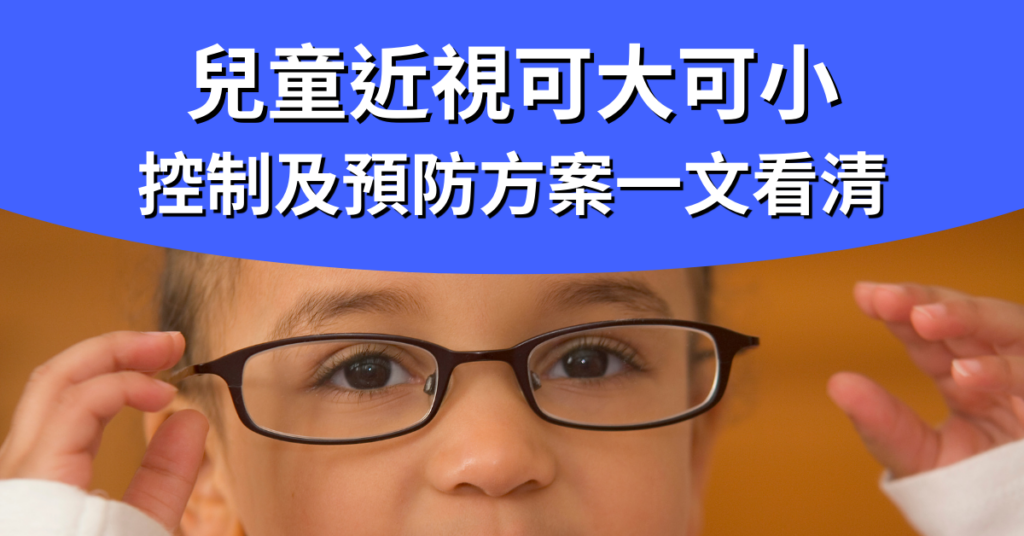
兒童近視可大可小

Children's myopia can be mild or severe! Clear it up with this article on control and prevention programs

Shortsightedness is one of the most common eye problems among children today. According to the Health Department, approximately 18% out of 6-year-old children in Hong Kong have shortsightedness; the rate is even higher for 12-year-old children, reaching 62%, which is far higher than in other Eurasian regions. Aside from poor eye habits, if parents themselves have high levels of shortsightedness, the chances of their children developing shortsightedness will also increase significantly. Therefore, early prevention and control of children's shortsightedness progression is extremely important.

Electronic products are the main cause of children's myopia

With the widespread use of electronic products, the age group of children with myopia is also gradually increasing. Many parents treat electronic products as "baby pacifiers"; at a stage when children's eyes have not fully developed, they develop a habit of relying on electronic products, which affects the normal development of their eyes.

Among children with myopia, up to 80% of cases are caused by poor eye habits. Prolonged viewing of electronic screens causes the pupil to adapt continuously to changing light conditions, causing the ciliary muscle to remain in a constant state of tension to regulate the pupil size. This leads to excessive eye fatigue and increases the risk of myopia in children. To prevent or control the degree of myopia in children, parents must strictly control their children’s time spent using electronic devices while encouraging them to participate in outdoor activities and reduce their dependence on electronic pacifiers.

Is there a difference between children's myopia being real or not?

However, there is also “true myopia” and “pseudo-myopia”; the former is caused by changes in the eye structure that cannot be naturally restored; the latter is the temporary fatigue of the eyes; proper relaxation of the eye muscles can improve it. Since the recovery methods for both types of myopia are different, it is important to first understand which type of myopia the child has.

Pseudo-myopia often occurs in children under the age of 12 because the pupils of children under this age are very strong. In addition, due to prolonged use of electronic devices in close proximity, the pupils cannot relax naturally, leading to pseudo-myopia. However, as long as the eyes are given adequate rest, children with pseudo-myopia can regain normal vision.

If you suspect that your child has vision problems, it is recommended that you seek immediate medical advice from an ophthalmologist. Typically, pseudo-children's myopia can be corrected; most cases are treated by using eye drops to relax the eye, thereby detecting the true refractive state of the eye and determining whether it is true or false myopia.

Although childhood pseudo-myopia can be corrected, this is also a major sign of myopia; if the child does not correct their eye habits in time, it may eventually become true myopia.

How to detect that a child has myopia?

Young children may not realize they have vision problems, so parents should pay extra attention and observe their children to determine if they have myopia or other vision problems. If the following signs of myopia appear, parents should take their children to see an ophthalmologist:

  • Frequently blinking or rubbing the eyes
  • Frequently rubbing the corners of the eyes or squinting to see distant objects
  • Frequently tilts their head to look at things
  • When looking at things, the eyes and the object are very close together.

What are the consequences of neglecting to control children's myopia?

Some parents believe that if a child's myopia is not severe, it is not necessary to address it. However, in reality, if children's myopia is not controlled, the refractive index will gradually increase with age, and even rapidly increase within a short period of time. If the child already has myopia problems at a young age, it is easy to cause the refractive index to exceed 500 degrees.

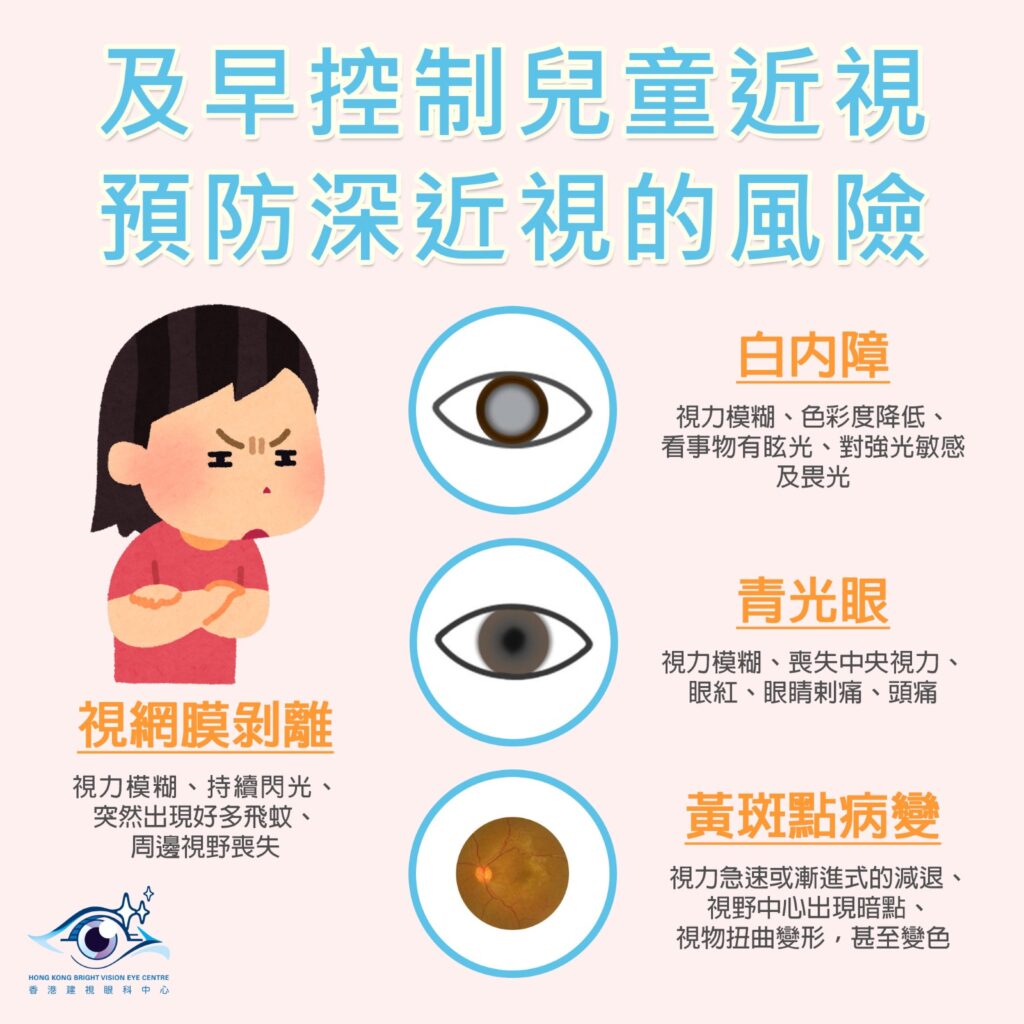
But do you think that’s all it takes to make myopia worse? No! The deeper the myopia, the greater the risk of developing eye diseases such as cataracts, glaucoma, and macular degeneration in the future; in severe cases, it can even lead to blindness.

  • Cataracts: The lens of people with high myopia tends to deteriorate and become cloudy, which increases the risk of developing cataracts.
  • Cataract: People with high myopia have higher eye pressure, and the risk of developing cataracts is four times that of normal people.
  • Macular degeneration: Among patients with myopia of up to 800 degrees and myopia of 10 years, approximately 5 to 10% patients have combined macular lesions.
  • Floaters: The vitreous humor of highly nearsighted people is prone to degeneration, resulting in fibrous-like suspended matter.
  • Retinal detachment: The retina of people with high myopia is prone to degeneration or atrophy, and the risk of developing retinal detachment is more than 20 times that of the general population.

Therefore, parents should actively monitor their children's near-sightedness and take control and preventive measures to prevent their children from becoming high-myopic in the future.

What are the methods for controlling children's myopia?

Generally speaking, the ideal rate of myopia progression for children should be no more than 50 degrees per year. If children's myopia increases by more than 100 degrees per year, it is considered an abnormal situation and may eventually develop into high myopia, which may also increase the risk of developing secondary complications. Therefore, in recent years, the medical community has been dedicated to researching various methods to control and improve myopia in children in order to slow down the progression of myopia in children.

Low-concentration atropine eye drops

Low-concentration atropine eye drops can inhibit excessive growth of the cornea and slow down the elongation of the eyeball, thereby controlling the deepening of children's myopia. Within 1 year, the deepening can be slowed down by 67%.

However, some children may experience side effects such as blurred vision after using low-concentration atropine eye drops, or difficulty seeing close objects; therefore, careful consideration should be given before using low-concentration atropine eye drops.

Corneal reshaping contact lenses (OK lenses)

Corneal reshaping contact lenses (OK lenses) are contact lenses worn at night for children with myopia of no more than 600 degrees. Their principle is to reshape the cornea through highly oxygen-permeable rigid lenses, allowing users to see clearly without wearing glasses during the day. Research has shown that long-term use of OK lenses can control the progression of myopia in children, generally slowing the rate of myopia progression to 50%–80%.

However, corneal reshaping contact lenses are only temporary vision correction; if they are stopped wearing, the degree of myopia in children will return to its original state.

Additionally, OK lens for controlling children's myopia usually costs between HK$5,000 and HK$10,000, plus the lenses need to be replaced every 9 months or so, so the price of these children's myopia control lenses may be somewhat expensive for some families.

Depth-of-field image stabilization (DIMS)

There are two types of distance vision lenses: the central portion is a normal near vision lens, and the surrounding portion is an optical element that utilizes the near vision distance effect to focus the surrounding image in front of the retina, thereby slowing down the eyeball elongation and controlling the speed of children's myopia. Research has confirmed that children who wear distance vision lenses experience a significant reduction in myopia over 2 years, reaching 52%.

Unfortunately, bifocal lenses are only suitable for children with myopia of no more than 650 degrees and astigmatism of no more than 400 degrees. Children with myopia exceeding this range must seek other control options. Moreover, the cost of these types of children’s myopia control lenses is not low either; currently, the price of commercially available children’s bifocal lenses starts at HK$4,000, which directly discourages parents who want to use lenses to control their children’s myopia.

An earlier method for controlling children's myopia—the Children's AI Myopia Control Program

As mentioned above, some eye drops used to control myopia in children can cause side effects. In addition, the prices of children’s contact lenses for controlling myopia on the market are currently too high, and with the so-called “prevention is better than cure,” parents are starting to realize that controlling their children’s myopia and the likelihood of their myopia deepening should not be started after they are diagnosed with myopia; rather, it should be started at an earlier stage to control the risk of myopia in children.

The Children's AI Myopia Control Program is a special project developed in Hong Kong in recent years. The prediction accuracy is as high as over 80%. The goal is to be able to predict the myopia development of children in the next 3 years in advance and customize individualized treatment plans in advance to control the progression or restoration of children's myopia.

The main process of the children's AI myopia control program is as follows:

  1. Fill out the questionnaire about the daily habits of your children
  2. Performing various eye examinations
  3. Importing inspection data and using AI and big data analysis to predict the myopia status of children for the next 3 years
  4. Parents and ophthalmologists can use reports and charts to understand whether the myopia development of their children is considered high-risk.
  5. Based on the evaluation results, ophthalmologists will customize personalized treatment for the child to slow down the progression of myopia in children and reduce the risk of high myopia.

Currently, Dr. Tong Wenjie, an ophthalmologist, is in charge of "Children's AI near-sighted control programIt has been validated in a sample of 129,242 adolescents, with a predictive accuracy of over 80%, helping to provide early warning of myopia in adolescents.

Parents can accurately predict their child’s future myopia changes through the “Child Myopia Control AI Smart Platform.” This AI platform uses big data intelligence to analyze the predicted results, allowing parents to observe the changes in their child’s refractive errors based on the predicted report (the parent can view this as a “refractive development file”). Ophthalmologists will also analyze the current myopia status of their child in detail based on the predicted report, comparing the normal refractive performance of the same age group with the general population, and formulating personalized myopia treatment plans.

Daily methods to improve or control children's myopia

To prevent or control myopia, in addition to seeking the help of an ophthalmologist, parents can also help children with myopia restore or improve their vision through daily life activities.

Establish correct eye-care habits

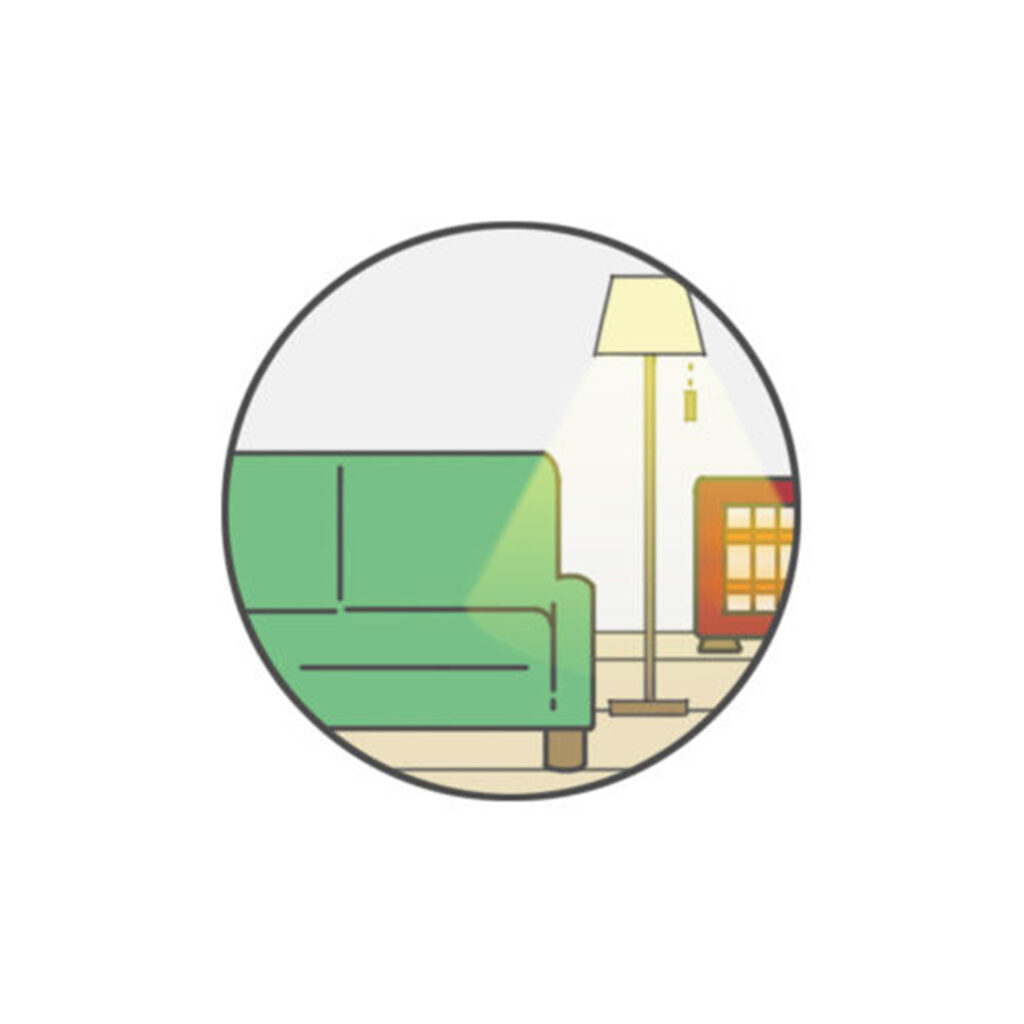
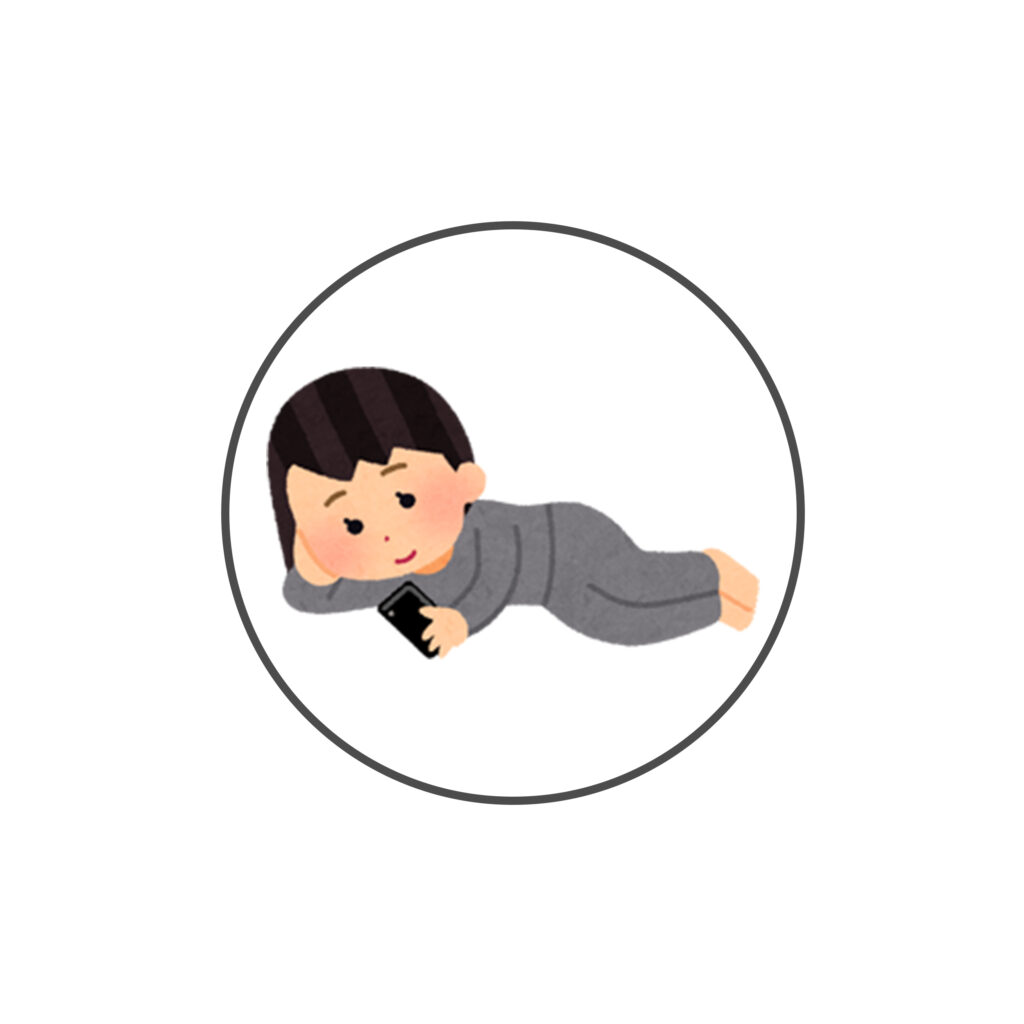
Whenever possible, children should maintain proper sitting posture when doing homework or reading. They should also avoid lying down or sleeping, and should also avoid reading or using mobile phones in dim light environments. Furthermore, children with myopia should control the time they spend using electronic devices each day and develop the habit of taking a 5-10 minute break every 30 minutes.

Eat eye-healthy foods

Parents can also provide their children with eye-healthy foods like vitamins A, C, E, lutein, and anthocyanins on a daily basis, which can help children with myopia recover or improve their vision.

Outdoor activities

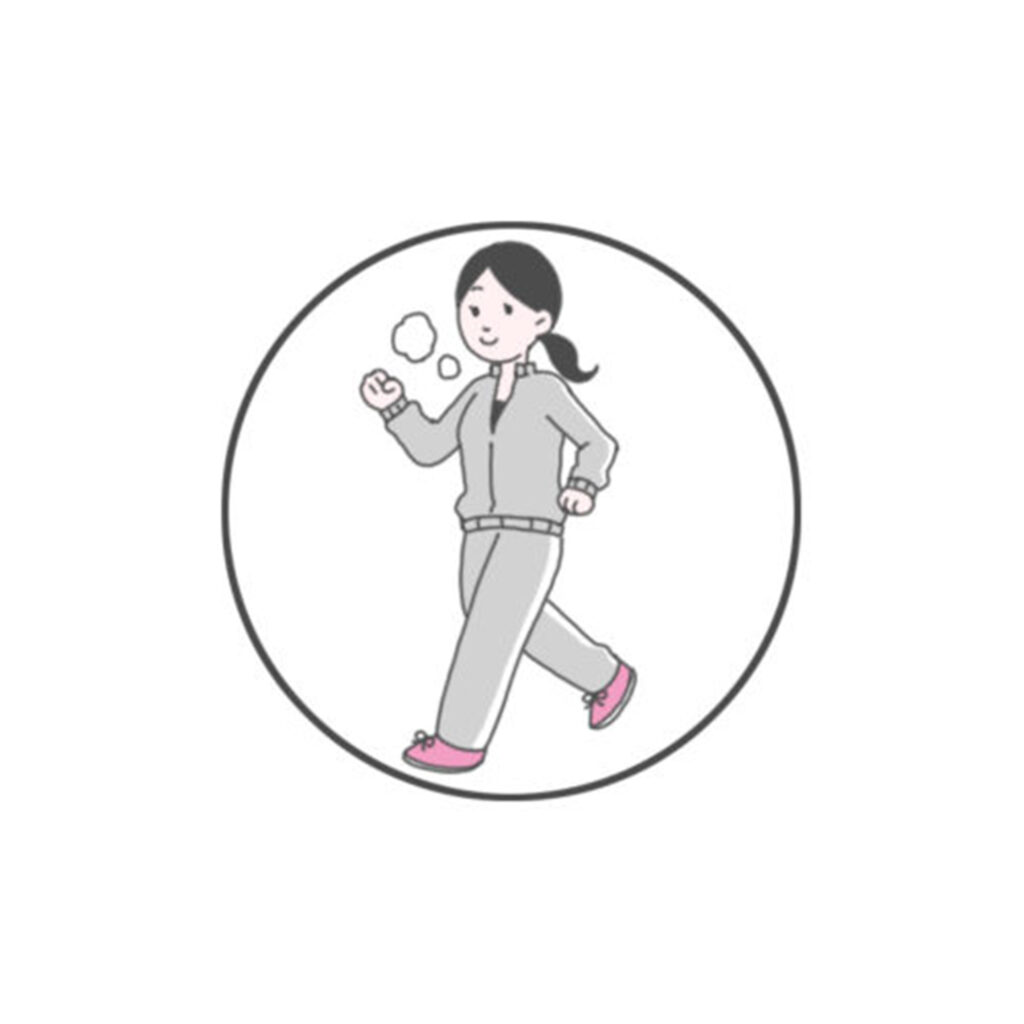
Parents are advised to take their children outdoors daily for activities such as playing in playgrounds and going for walks in parks. This will reduce their time using electronic devices, and the sunlight outdoors can also stimulate the secretion of retinal dopamine, effectively controlling the progression of myopia in children.

The development of myopia in children is extremely rapid; even a slight lapse in attention can lead to a rapid increase in the refractive index. Therefore, in addition to supervising children to cultivate good eye habits in daily life, parents are advised to regularly have their children undergo eye examinations. Once abnormalities are detected, appropriate control measures and treatment plans can be implemented in time to ensure the healthy vision of children.

Children's myopia can be mild or severe! Clear it up with this article on control and prevention programs Read More »

封面圖_兒童近視_控制方面_注意

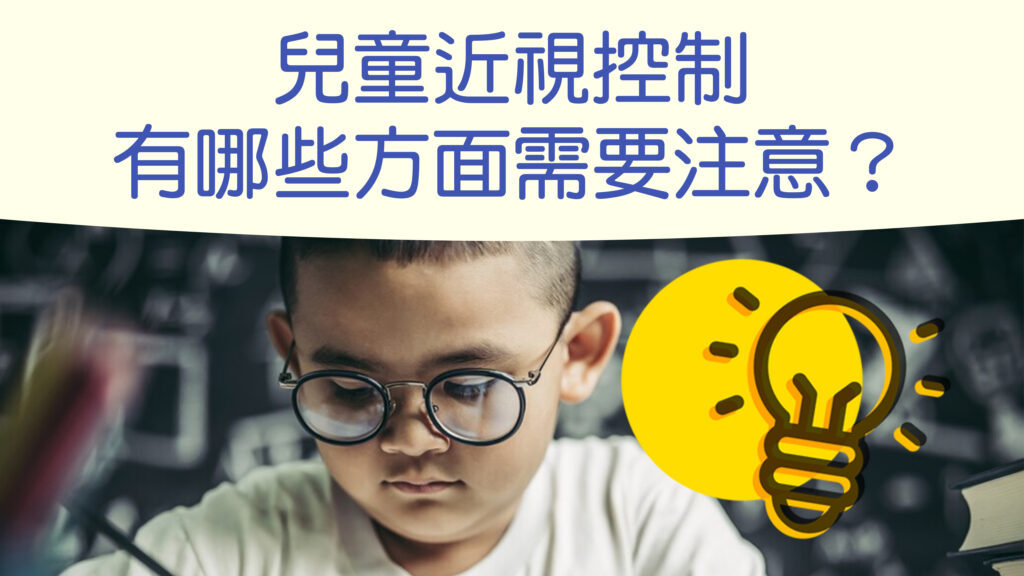
Tips for Controlling Childhood Myopia

What aspects of children's myopia control need attention? Smart eye care tips you need to know

Nowadays, children often use computers for school lessons; even when they are not in school, they still frequently use mobile phones and tablets. This leads to the phenomenon of “not taking the device off their hands,” and many children are therefore prone to develop myopia from an early age. A survey has shown that half of children aged 4 to 12 who suffer from myopia during the pandemic have been taught to study using electronic devices, which has led to the worsening of their myopia levels and may very well lead to deep myopia in the future, possibly causing more serious eye problems. Therefore, as parents, it is essential to teach children from an early age to protect their eyes and to take good care of them.Child myopia controlTo avoid worsening myopia, here are nine tips that I would like to share with you: When using smart phones, computers, the Internet, or reading, please be mindful of the following:

Every 20 minutes, give your eyes a break.

Keep sufficient light source when reading

Maintain a distance of at least 30 centimeters.

Adjust the screen brightness to a comfortable level

Do not watch while lying in bed or in a car.

Increase the time spent doing daily outdoor activities

Go to bed and wake up early every day

Eat more foods rich in vitamin A
For example, carrots

Get comprehensive eye exams early and regularly

Tips for Controlling Childhood Myopia Read More »

封面圖_兒童近視的成因_近視症狀

Causes and symptoms of childhood myopia

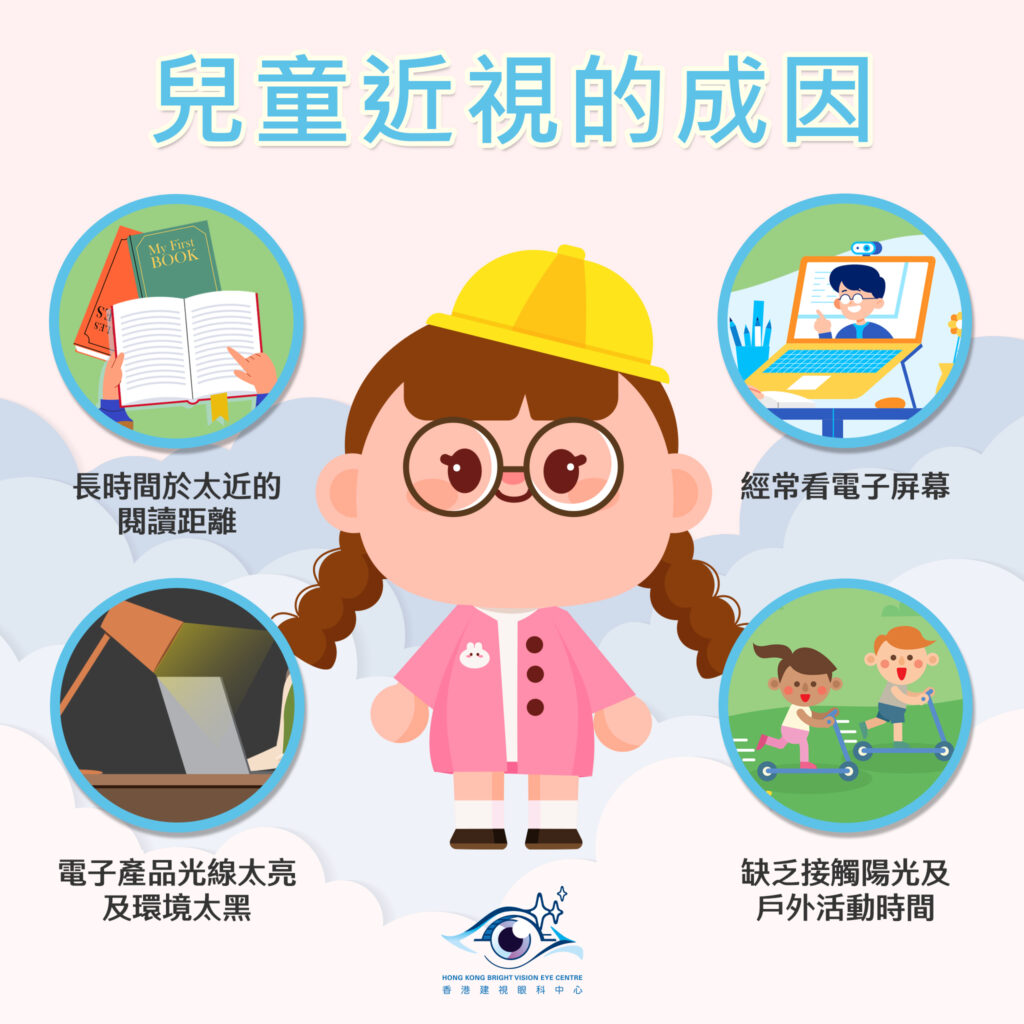
兒童近視的成因

香港是全球患近視比率最高的地方之一,大約有接近18%的兒童在6歲時已患有近視!究竟是甚麼成因造成兒童近視呢?

Myopia(Myopia)是由於眼軸過長,在眼睛調節放鬆望遠的狀態下,平行光線經眼球屈光系統後聚焦在視網膜之前,造成看遠的景物模糊不清,看近的景物則比較清楚。

近視可以是先天遺傳,但後天環境因素亦是導致近視的主要成因,例如:

  • 長時間於太近的閱讀距離
  • 電子產品光線太亮及環境太黑
  • 經常看電子屏幕
  • 缺乏接觸陽光及戶外活動時間

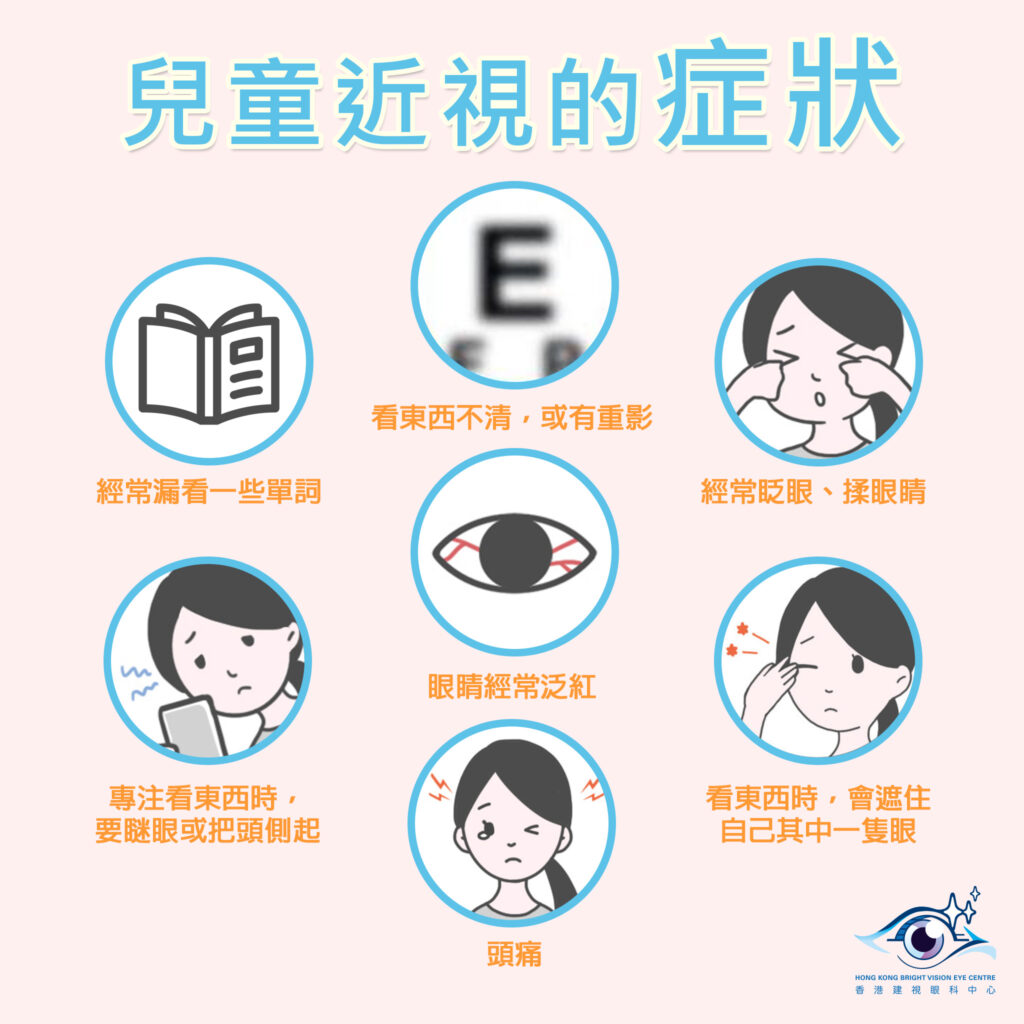
兒童近視的症狀

點樣發現小朋友患上近視?
家長需要經常留意小朋友有沒有出現以下行為:

  • 訴說自己有頭痛
  • 訴說自己看東西不清(或有重影)
  • 經常眨眼、揉眼睛
  • 眼睛經常泛紅
  • 專注看電子屏幕或看書時,要瞇眼或把頭側起才能看清
  • 看電子屏幕或看書時,會遮住自己其中一隻眼 
  • 閱讀時經常會漏看一些單詞

如果家長發現小朋友經常出現以上行為,好大機會患有近視,建議家長盡快帶子女驗眼,向眼科醫生諮詢專業意見。

Early control of children's myopia
可預防加深近視的風險

兒童近視 不可忽視!

小朋友經常看電子屏幕,患上近視的機會大大增加。如果家長發現子女患有近近,建議向專業眼科醫生諮詢,採取適合的矯視治療。現時有一項「Children's AI near-sighted control program」,此計劃可以預測小朋友三年後的近視變化,從而可為小朋友提供個人化近視矯視治療方案。

若不採取矯視治療的話,很大機會令近視度數加深,眼軸增長會導致視網膜越來越薄,同時增加患上各種眼科疾病的風險,例如造成Retinal detachment、Macular degeneration,Cataract及Cataract等,這些併發症都會影響視力,嚴重者甚至失明,喪失視力,因此建議盡早控制兒童近視,矯正要及時!

及早帶小朋友驗眼,可有效避免或延緩出現近視加深的情況,減低將來變成深度近視的機會及風險。

各位家長記得提醒小朋友,由改善日常生活習慣開始,從小好好保護眼睛!

Causes and symptoms of childhood myopia Read More »

精選圖片_白內障症狀

Do cataracts have to be “ripe” before surgery? Understanding the causes and symptoms of cataracts

白內障初期無法從外觀判斷,須經過眼科細隙燈儀器檢查才能確定。在初期,水晶體會由透明狀,逐漸變黃,甚至產生深咖色,也就是俗稱的「變熟」。白內障的形成是水晶體的蛋白質因變異而導致混濁,混濁後就不可回復,所以目前無法靠吃藥或點藥水使白內障回復。

因此,進行Cataract surgery搭配Artificial lens置換是目前臨床上唯一有效的治療方式。

白內障症狀

白內障最常見的症狀是視力逐漸模糊,一般而言,早期的白內障的症狀並并不明顯,當病情逐漸加重時,患者便會發現:

  • 視力模糊,原本清晰的影像變得朦朧:白內障所導致的視力模糊會讓患者難以看清眼前事物,尤其在較暗的環境下,老人家可能會因爲看不清而容易跌倒。
  • 眩光:在太陽光或較强的光線下,患者可能會感覺有眩光或閃光,大大影響在明亮環境中的視覺舒適度。
  • 雙影:白內障可能導致看東西有重影,使得物體看起來彷彿有重疊或分離的感覺,在這種情況下老人家可能會在行走時失去平衡,增加摔倒的風險。
  • 近視度數加深而以為老花眼減輕:有老花眼的患者可能會注意到他們看近物時變得清晰,會誤以為是老花眼的症狀減輕,實際上這可能是白內障引起的視力變化。

白內障的初期症狀可能並不會影響日常生活,但隨著時間推移,水晶體混濁的部分可能會隨之擴散,導致更明顯的白內障症狀,甚至失明。

如果您有白內障症狀或發現視力有任何變化,請立即向我們的眼科醫生約診。

白內障自我檢查

儘管白內障自我檢查無法替代專業眼科檢查,但有些簡單的觀察和注意事項可以讓你察覺是否存在潛在的白內障症狀。如果您發現已有白內障先兆,應及早諮詢眼科專業醫生的建議。

以下是一些白內障自我檢查的指南:

  1. 是否感覺遠近事物總是模糊不清?
  2. 是否感覺老花眼突然改善?
  3. 是否會怕光?
  4. 是否會感覺事物有重影、眩光/光暈?
  5. 是否會感覺看東西顔色偏黃/不鮮艷?
  6. 是否發現近視度數不斷加深?

若符合以上其中數項,亦有可能是罹裏患白內障的先兆,請儘早與我們的眼科醫師預約,進行專業的檢查和診斷,及早發現和治療白內障有助於維護良好的視力和生活品質。

最常見的白內障成因

白內障主要成因是水晶體老化,是老人家常見的眼疾,但亦有可能由其他原因引起。以下是一些其他常見的白內障成因:

Diabetes

白內障被認爲是糖尿病患者視力問題的主要成因。這是因為糖尿病患血液中的糖分較高,高血糖會使水晶體腫脹及混濁,最終形成白內障。

外傷

眼睛受到外傷或創傷也可能成爲白內障的成因之一。這可能包括眼部手術、事故或其他傷害。

發炎

眼部組織的發炎可能導致白內障的發展。這可能是由於眼睛感染、眼部疾病或其他炎症性疾病引起的。

Genetics

家族遺傳也有可能是白內障的成因之一。如果家族中有人患有白內障,其他成員可能也更容易患上白內障。

長期服用類固醇

長期使用類固醇或在高劑量下使用類固醇都會增加罹患白內障的風險。這是因為類固醇可能會使水晶體變質,影響水晶體的透明度和正常功能。

High myopia

高度近視者(200~300度)是白內障的高風險群體。這是因爲高度近視者的眼內結構已發生變化,這可能會增加水晶體的負擔,進而導致水晶體加速老化,最終促使白內障的形成。

了解這些白內障的成因有助於更好地預防及發現白內障的早期症狀,以獲得最佳治療時期。如果有白內障的病徵或風險因素,應及早向眼科醫師諮詢。

白內障種類

雖然白內障的最終治療方案都是微創手術,但眼科醫生都會在術前分析及瞭解患者罹患白內障的成因及症狀來判斷患者屬於哪一類型的白內障,避免錯過最佳治療黃金期。臨床上,我們大致將白內障分成6類:

核心型白內障

核心型白內障是最常見的白內障類型,常發生在40歲左右的人身上,不過高度近視者有可能會更早發生。核心型白內障即水晶體從中間開始「[熟」],由於這類白內障發展較緩慢,大部分人在初期時不會有視力問題,甚至有些原有老花的人會覺得自己的老花眼有所改善。然而,隨著白內障逐漸成熟,視力便會快速下降,而且看到的顔色也會因爲光線進入的角度關係而導致辨別顔色能力減弱。

皮質型白內障

皮質型白內障發生在外圍皮質層,這種類型的白內障更好發於糖尿病患者。皮質型白內障的成因是由於水晶體皮質的變質造成混濁,導致水晶體周邊模糊,看不清楚。這類白內障在初期時症狀較不明顯,但它會漸漸向核心部位蔓延,就會開始產生視力模糊問題。

後囊型白內障

後囊型白內障由許多小斑點形成,主要發生在水晶體後囊膜的中央,與後囊膜老化或上皮細胞生長過度有關。這些小斑點會遮擋光線,使光線無法完整的到達視網膜,導致患者在强光下看事物時變得模糊、顔色不鮮艷;在夜間時則會看見眩光、光暈等問題。這類白內障通常比其它類型的白內障發展更快,尤其常發生在長期或大量服用類固醇的病患身上。

先天型白內障

先天型白內障是指在出生時就存在的白內障。這可能是由於遺傳因素、母體感染或其他胎兒發育問題所引起的。

續發型白內障

續發型白內障是由其他眼部問題或全身性疾病引起的。例如糖尿病、眼部炎症或使用某些含有類固醇藥物都可能導致續發型白內障。

創傷型白內障

創傷型白內障是由眼部創傷而引起,包括眼球受傷、手術後併并發症或其他意外事故。這些創傷可能導致水晶體混濁,進而影響視覺。

若感到視力異常或發現有白內障的病徵,建議及早就診查明病因,以免延誤診治。

過熟做白內障手術後遺症

一旦發生白內障,什麼時候要接受手術?在還沒有超音波晶體乳化術的年代,白內障手術傷口大,縫合時間以及恢復期較長,因此都是等到水晶體很熟很硬才開刀。目前因為「超音波晶體乳化術」的普及,白內障手術的成功率非常高,傷口很小,恢復快。

此外,因為一旦白內障過熟時,還可能併發青光眼、虹彩炎,嚴重可能失明,也增加手術的困難度。因此,手術最佳時機是只要發現白內障症狀明顯或視力已影響日常生活,就建議動手術更換水晶體。但若拖到此時才動手術,時機已經太晚。

了解更多白內障術後應該如何保養?

Do cataracts have to be “ripe” before surgery? Understanding the causes and symptoms of cataracts Read More »

Presbyopia laser eye surgery

How to improve farsightedness? These 3 methods you should know!

老花眼是一種與年齡有關的自然衰老現象,使人失去清晰看近物體的能力。每個人的生活中都會出現老花眼。即使一個人擁有一生的完美視力,也將開始看近物聚焦時遇到困難,特別是在執行如穿針的任務時。

目前沒有老花眼的根治方法。但是,有幾種治療方法可以糾正您的視力。根據您的狀況和生活方式,您可能可以選擇矯正眼鏡,隱形眼鏡, 激光矯視 或手術來矯正視力。

選擇佩戴適合的老花眼鏡

漸進鏡片上部設置為遠距離,而下部設置為近距離作業。但是,它們沒有可見的線,並且在處方的遠處和近處之間提供了更漸變的過渡效果。因為近視性老花與遠視性老化的佩戴需求不同, 我們不建議自行購買老花眼鏡 。

(Laser Blended Vision) LBV老花激光矯視

可彌補monovision技術的不足,為病人同時創造「融合區」(Blend Zone),藉以提供良好的近,中,遠距離視力,亦不會影響原有的色差及立體感敏銳度。

Cataract surgery

如果老人家有白內障,可以選擇一隻眼 (主力眼) 做到0度以方便去看遠景物,而另一隻眼 (非主力眼) 做到50至150度近視 (單眼視覺矯正)。但是,這種方法並不適合所有人。有些人發現根本無法適應。眼科醫生通常建議在進行手術之前先嘗試使用隱形眼鏡進行單眼視覺矯正測試。另外亦可以考慮放置多焦距的人工水晶體,以調節老花的程度。然而,醫生需要與患者討論可能的副作, 如出現光暈,眩光和較低的對比敏感度等視覺症狀。

How to improve farsightedness? These 3 methods you should know! Read More »

High myopia threatens vision; the symptoms of cataracts cannot be ignored

High myopia threatens vision; the symptoms of cataracts cannot be ignored

High myopia is a relatively severe level of myopia. Myopia of 600 degrees or more is medically defined as high myopia. Its formation is related to changes in the length of the eyeball. The normal length of the eyeball in adults is 22-27 mm. If the length is greater than 27 mm, it will cause high myopia. In almost all cases, heredity is closely related to the development of high myopia. If both parents are nearsighted, their children are also more likely to develop high myopia. High myopia itself usually does not cause a decrease in visual acuity. However, people with this condition are more likely to develop several other vision-threatening diseases, including:  

  • Retraction of the retina 
  • Cataract 
  • Cataract 
  • Retinal holes or even detachment
  • Macular degeneration and bleeding

Even though laser refractive surgery can alleviate high myopia, it cannot prevent complications.

In recent years, some high-myopic patients have undergone laser refractive surgery, and their myopia has decreased. As a result, they have forgotten to continue monitoring the potential problems that high myopia could cause in the first place. However, in reality, laser refractive surgery only changes the curvature of the cornea, and does not change the length of the eyeball. Therefore, all complications resulting from the eyeball being too long will not be reduced by laser refractive surgery!

High myopia causes cataracts to deepen faster

In a recent study of the outcomes of cataract and cataract surgery in high-myopic patients, researchers found that cataracts in high-myopic eyes developed more quickly than in normal-sighted eyes. Additionally, the prevalence of comorbid diseases and complications (such as retinal detachment) in high-myopic eyes was higher.

Therefore, people with high myopia must undergo regular eye examinations so that their ophthalmologist can monitor the health of their eyes and look for signs of these symptoms and other complications of severe myopia.

High myopia threatens vision; the symptoms of cataracts cannot be ignored Read More »

Will wearing glasses for nearsightedness deepen it? How can I prevent it from deepening?

Will wearing glasses for nearsightedness deepen it? How can I prevent it from deepening?

Will wearing glasses for nearsightedness deepen the problem?

There has always been a misunderstanding that parents advise children to delay starting to wear glasses, to minimize the time they wear them, or that glasses with a shallower prescription can prevent myopia from worsening.

Dr. Yu pointed out that the opposite is actually true: glasses with the right prescription can help you easily identify distant objects.

Conversely, using unsuitable lens prescriptions can lead to nearsightedness and may worsen your myopia.

If you experience headaches or eye fatigue when wearing glasses, this may mean that your prescription is too high or too low.

Of course, many people also have doubts: "I almost always wear glasses, but my vision is actually getting worse?"

If this happens, the reason may be that the child's eyeball is constantly growing, elongating, and the refractive index naturally increases.

Furthermore, if you have poor eye habits and stare at the screen for a long time, it will trigger nearsightedness.

Therefore, when reading on a mobile phone or tablet computer, please remember to do so in well-lit environments, lower the brightness of electronic devices, adjust the font size and spacing to a moderate level, and reduce eye strain;

How to prevent myopia from getting worse?

Dr. Yu advises you: every 20 minutes of reading, look 20 feet away for 20 seconds; take a 20-second break to allow the ciliary muscles to rest and relax sufficiently.

There is no evidence that exercises such as massaging the area around the eyes can help slow the progression of myopia in children.

On the contrary, over-stretching the muscles around the eyes can cause the eye pressure to rise.

In addition, people with high myopia who rapidly turn their eyeballs also have a risk of retinal detachment.

Parents misunderstand that laser vision correction can reverse nearsightedness.

In fact, increased nearsightedness means the eyeball becomes longer; there is no way the eyeball can be shrunk back to its length when the child's vision is intact.

Laser vision correction changes the curvature of the cornea, allowing light to focus on the retina without the help of glasses or contact lenses.

The eyeball can still continue to grow.

Therefore, it is best for parents to let them participate in outdoor activities.

A study in Australia found that children who spend up to 14 hours outdoors per week help stimulate the secretion of dopamine and slow the progression of myopia.

Perhaps you are also interested in:

What is pseudo-myopia? Can pseudo-myopia eye drops be used to distinguish between genuine and fake myopia? — Sometimes it’s not actually nearsighted; it just happens suddenly after overusing the eyes.

High myopia threatens vision; the symptoms of cataracts cannot be ignored — 高度近視本身通常不會導致視力下降。但是,患有這種疾病的人更有可能患上其他幾種威脅視力的疾病

#The consequences of nearsightedness without glasses # #: What happens when you don't wear glasses? Nearsightedness Without Glasses #Nearsightedness Without Glasses

Will wearing glasses for nearsightedness deepen it? How can I prevent it from deepening? Read More »

3 The latest methods for preventing myopia in children in Hong Kong—did you know about them?

3 The latest methods for preventing myopia in children in Hong Kong—did you know about them?

Near-sightedness rate among children in Hong Kong

The myopia rate among Hong Kong schoolchildren increases with age, from 6.3 in pre-school children to 18.3% in 6-year-olds, and further increases to 61.5% by age 12%, while the rate among adults aged 21–30 is as high as 84.7%.

If it progresses to near-sightedness, the risk of developing various eye diseases later in life, such as retinal detachment, cataracts, glaucoma, and macular degeneration, will increase significantly.

The purpose of children's vision correction is not to completely stop myopia from deepening, but to slow down the rate of myopia deepening.

Preventing myopia

If a child's myopia increases by 100 degrees each year, it is considered to be rapid progression of myopia, so it is advisable to consider treatment. For children, the ideal progression rate is within 50 degrees per year.

Low-dose atropine eye drops are commonly used by ophthalmologists in recent years as a first-line method to slow down children's myopia.

Research from the University of California, Davis shows that this method can effectively slow the progression of myopia in children by up to 60%, and has few side effects.

In addition, a “multi-zone forward optical defocusing” (DIMS) lens designed by Hong Kong Polytechnic University has been proven to slow down the progression of myopia in children participating in the study by up to 60%.

Eyeglass lenses consist of a "central optical zone" used to correct refractive errors, and "multi-zone continuous near-sighted defocusing" extending around the central zone to the periphery of the lens.

When worn by the wearer to view objects at different distances, DIMS lens provides clear vision and near-focusing, correcting vision and helping to slow the progression of myopia.

Finally, children can choose to wear corneal refractive lenses (OK lenses).

It uses special rigid corrective contact lenses and the tension of tears to change the curvature and shape of the cornea.

Children who undergo vision correction can simply wear the corrective lenses at night to sleep, and the advantage is that they don't need to wear glasses in the morning.

The only concern is that children may inadvertently rub their eyes during sleep, causing corneal damage or infection. Therefore, this method is only suitable for children who are able to manage themselves well and are over 8 years old.

3 The latest methods for preventing myopia in children in Hong Kong—did you know about them? Read More »

What is pseudo-myopia? Can pseudo-myopia eye drops be used to distinguish between genuine and fake myopia?

What is pseudo-myopia? Can pseudo-myopia eye drops be used to distinguish between genuine and fake myopia?

What is pseudo-myopia?

Once a child develops myopia, parents become extremely anxious and often ask, "Does the child have a true degree of myopia if they are tested?"

We already know that the eyes can see both near and far distances; it is mainly the ciliary muscles and the crystalline lens that regulate this process, allowing the image to be focused on the retina so that we can see objects clearly.

We need to know the main symptoms of nearsightedness: seeing things blurry when looking far away.

However, if this happens suddenly after excessive eye strain, please don't rush to get new glasses right away; you could be suffering from pseudo-myopia.

Looking at things up close for a long time causes the ciliary muscles to contract excessively; when looking at distant objects again, the inability to relax immediately causes the focus position to shift, resulting in blurred vision.

Pseudo-myopia often occurs in schoolchildren, because children's eyelid muscle regulation function is more powerful.

Additionally, the most prominent characteristic is that visual acuity changes from time to time; especially when looking at near objects and then turning to look at distant objects, it becomes blurry.

Furthermore, nearsightedness is less common when combined with astigmatism.

How to distinguish fake nearsighted eye drops from the real ones

If pseudo-myopia is treated as true myopia by wearing corrective lenses, the patient’s eyes will be very uncomfortable because the factors that cause the ciliary muscle to contract are not relieved.

Finally, the doctor will use eye drops containing a bulking agent for the ciliary muscle to enlarge the pupil and relax the ciliary muscle, thereby distinguishing between true and false nearsightedness.

How to achieve improved pseudo-myopia?

However, parents should not worry too much; this situation is temporary.

As long as diagnosis and treatment are carried out in a timely manner, and the factors that cause pseudo-myopia are eliminated concurrently, such as paying more attention to reading distance and posture when writing, frequent looking at distant objects to relax the ciliary muscles, the increased myopia can still be corrected.

It is worth noting that today, students carry tablets and mobile phones with them at all times, causing the ciliary muscles to remain in a state of tension for long periods of time, even leading to premature degeneration and the inability to contract and regulate the muscles. This can lead to "fake reality."

Therefore, if you notice that your child has vision problems, you should take them for an eye examination as soon as possible.

What is pseudo-myopia? Can pseudo-myopia eye drops be used to distinguish between genuine and fake myopia? Read More »

Five key points about baby eye protection methods and the causes of myopia (plus a vision check that you can try at home in Hong Kong)

Five key points about baby eye protection methods and the causes of myopia (plus a vision check that you can try at home in Hong Kong)

As a parent, of course, we are concerned about our children's eye health.

Five key points of "eye protection methods"

According to statistics, infants are born with a near-sightedness of about 250 degrees, and they can only see black-and-white images before they are half a year old.

Therefore, it is best to place patterns with high black-and-white contrast to stimulate the baby's visual development.

In addition, soft natural light is crucial for helping infants develop their vision.

It is recommended to keep the curtains open during the day to allow the baby to receive light stimulation, but remember to avoid direct sunlight hitting the baby's eyes.

Because children as young as one year old still have developing vision and their pupil dilates slowly, overly bright light can harm a baby's eyes, so when taking photos you must turn off the flash.

After six months of age, parents can shake colorful patterns in front of the child's eyes at a distance of 30 centimeters.

This can cultivate the coordination of the child's eyes and train their focusing ability.

Eye-vision check can be tried at home in Hong Kong

If you suspect your baby has poor eyesight, you might want to perform some simple self-tests at home.

First, the baby's vision will change as the light moves; secondly, parents can use a clean gauze cloth to cover one of the baby's eyes and then observe whether the baby's activity patterns change during wakefulness.

If the baby looks at things with a poor eye sight, the blurred vision will be different from usual conditions. The baby will become anxious and restless, and will keep crying. This should be further examined.

Caused by "near-sightedness"

In addition, any form of close-up work will cause nearsightedness.

Long-term near-focusing work on the eyes increases the strain on the ciliary muscles, causing the eyeball to become elongated.

The American Pediatric Society has issued guidelines stating that children under the age of two should not be exposed to electronic devices; for children aged 2 or older, the time spent using electronic devices should ideally not exceed two hours, with adjustments made as needed based on the child’s learning needs.

Five key points about baby eye protection methods and the causes of myopia (plus a vision check that you can try at home in Hong Kong) Read More »