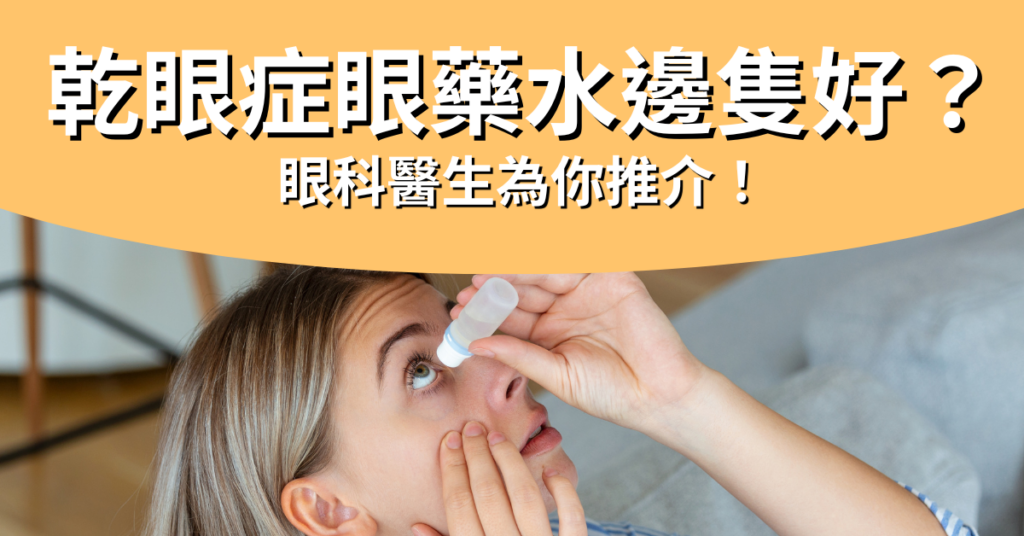
Even though I’ve been using eye drops every day, why is my left eye still so dry and watery? Even when my vision is clear in the morning, it’s still blurry when I close my eyes. After I finish applying the drops at work in the morning, it starts to dry again before noon, so I have to apply them again. But have you noticed that the effectiveness of the eye drops is getting shorter and shorter, from 2-3 hours originally to 1 hour, half an hour, or even immediately after I finish applying them? It’s not that I’m not diligent enough in applying the drops; it’s that I might be applying them in the wrong direction. Many people think that dry eyes are caused by a lack of water, and they keep applying artificial tears; but in fact, most people with dry eye syndrome are lacking oil rather than water. When there isn’t enough oil in the tear film, the water evaporates extremely quickly within seconds, and no matter how much artificial tears I apply, it only provides temporary relief and cannot solve the underlying problem. In fact, the preservatives in the eye drops can even cause the cornea to become even more damaged.
Why does it get drier the more you drip? You might be doing it wrong all along.
Many people's experiences are quite similar: at first, the eyes feel a little dry; you go to the pharmacy and buy a drop of eye drops; after using it, you feel immediately comfortable. So you start relying on it, keeping one in your home, one at work, and one in your bag. At first, maybe once a few hours is enough, but gradually it becomes once every two hours, once every hour, and eventually, you may have to drop it every half hour.
At that point you might think, "Is my dry eye condition getting worse?" or "Is this eye medication not good enough; should I switch to a more expensive one?" So you try another one, a third one, and try both the expensive and the cheaper ones, but the results are always the same: after a comfortable five minutes of use, it's dry again.
The problem isn't with the eye drops themselves; it's that you're using the wrong method in the first place.
Many people think that dry eyes are caused by a lack of tears, so they need to “replenish the moisture”. But tears actually have three layers:
- Oily layer(The outermost layer, secreted by the meibomian glands, is responsible for locking in moisture.)
- Water layer(Middle layer, the main component is water)
- Mucous layer(The innermost layer, helping the tears adhere to the surface of the cornea)
If your problem is a lack of oil production, which means that your meibomian glands are malfunctioning and unable to secrete enough oil to coat the surface of your tears. Even if you keep moisturizing, the water will evaporate quickly, just like using a leaky cup that never fills up completely.
Even worse, many eye drops on the market contain preservatives (especially the large-volume ones that can be used repeatedly). Preservatives are intended to prevent bacteria from growing, but if you use them several times a day, the preservatives accumulate on the surface of the cornea, causing damage to the cornea and making dry eye syndrome even more severe. That’s why you might feel like you’re “dripping more and more.”
Water shortage vs oil shortage: Most people are mistaken
Dry eye syndrome is actually divided into two main categories:
Aqueous Deficient Dry Eye
This is due to insufficient tear gland secretion, which truly means "lack of water." It is common in autoimmune disease (such as dry eye), older age, or the side effects of certain medications. This condition is relatively rare.
Oily/Vesicular Dry Eye (Evaporative Dry Eye)
This is a form of meibomian gland dysfunction (MGD), which causes insufficient or poor quality sebum secretion and rapid evaporation of tears.This is the most common type of dry eye syndrome.It is also most common among urban residents.
If you belong to the second type (most people are), then no amount of moisturizing artificial tears will be of any use because you’re not dehydrated; you’re just unable to retain water. It’s like your air conditioner is broken and it doesn’t cool, but you keep adding more ice cubes; the problem is that the compressor is broken and adding more ice cubes won’t help.
How do you know which type you are?
It's hard for you to make an accurate judgment on your own. But there are some clues you can refer to:
- If you finish applying the eye drops and they dry again within a few minutes, there is a very high chance that you are suffering from a lack of lipids.
- If you often have oil particles at the edge of your eyelids, or if you have particularly much morning-time eye mucus, it may be due to clogged meibomian glands.
- If you have recurring eyelid twitching (eyelid twitching), there is a high chance that you have a dysfunction of the palpebral gland.
- If you sometimes feel like you're tearing up but at the same time your eyes feel dry, that's called "reflexive tearing," and it's also a symptom of dry eye syndrome.
But the most accurate method is to have an ophthalmologist perform a professional examination to confirm the exact condition you are experiencing.
Eye drops available on the market: Which one are you using?
When it comes to eye drops, many people go to the pharmacy and ask, “Do you have any eye drops?” “My eyes are very dry.” But in fact, the effects of different types of eye drops are very different.
1. Ordinary artificial tears (containing preservatives)
Characteristics: Large capacity, reusable, usually the cheapest
Ingredients: Mainly water + preservatives (such as BAK)
Suitable for: Occasional dry eyes; apply 1-2 drops daily
Question: If you use more than 4 drops per day, the preservatives will accumulate in the cornea, making the eyes even drier and more uncomfortable.
2. Artificial tear without preservatives (single-use package)
Characteristics: Independently packaged; once opened, use immediately; usually more expensive.
Ingredients: Mainly water, no preservatives.
Suitable for: Recommended for frequent use by those with sensitive corneas
Question: Only replenishes moisture, not oil; it has limited effectiveness for oily dry eye syndrome.
3. Lubricating eye drops/gels
Characteristics: The texture is more viscous, and when you finish applying it, you may experience a brief blurring effect.
Ingredients: Containing mineral oil, lanolin or other fatty ingredients
Suitable for: Oily and dry eye syndrome due to lipid deficiency, use at night
Question: There are few options on the market, and if the meibomian glands are already severely clogged, applying external oil alone will only treat the symptoms.
4. Prescribed anti-inflammatory eye drops
Characteristics: Requires a doctor's prescription; usually contains steroids or immunomodulators
Ingredients: Such as Cyclosporine, steroids, etc.
Suitable for: There is significant inflammation and autoimmune dry eye syndrome.
Question: It can only be used after a doctor has evaluated it; you should not buy it without consulting a doctor.
Most people who go to pharmacies usually buy the first or second type, which is the “hydrating” type. But if you have oily-deficient dry eye syndrome (the most common type), then the effects of the drops you apply will be very limited.
💧 Want to know how severe your dry eye is?
It takes 2 minutes to complete.Dry Eye Syndrome Index (OSDI) assessment questionnaireGet a preliminary understanding of how dry eyes affect your daily life and take early control of your eye condition.
👉 Complete the OSDI Dry Eye Assessment Questionnaire immediately
Why can't eye drops solve the problem alone? The dysfunction of the meibomian glands is the key factor.
If your eye drops have gone from being applied twice daily to 10 times daily, but the effect is getting weaker and weaker, then you have to face the fact that:Eye drops alone won't solve your problem.
The root cause of the problem is your meibomian glands. The meibomian glands are tiny glands located inside the upper and lower eyelids. There are about 30-40 glands on each eyelid. Their job is to secrete oil, and every time you blink, that oil is evenly applied to the surface of the eyeball, forming a protective film that prevents the tears from evaporating.
But why do eyelid glands become problematic?
- Age increase: After the age of 30, the function of the meibomian glands begins to decline, and the secretion of oil decreases.
- Hormonal changes: Especially for women, hormonal changes around menopause can affect sebum secretion.
- Makeup habits: Cosmetic products such as eyeliner and eye serum will clog the eyelid gland opening.
- Eye habits: Long time use of computers and mobile phones reduces the frequency of blinking, and the oil cannot be evenly distributed.
- Chronic inflammation: Inflammation of the eyelid margin (blepharitis) can cause the glands to become blocked.
- Worm-shaped mites: Excessive reproduction of mites at the base of the eyelashes causes clogged glands.
When the meibomian glands become blocked, the oil inside them becomes thick and hardened, unable to be properly drained. Over time, the glands may shrink and even permanently lose their function. At that point, even though you apply as many eye drops as you want, they only provide water replenishment; they cannot lock in the water, so the effect is very short-lived.
Why can't it be done by applying heat to relieve congestion?
You might be thinking, "So can I do a heat therapy treatment?" Online says that heat therapy can dissolve the oil. Heat therapy definitely helps, but there are a few problems:
- Temperature difficult to control: To effectively dissolve the oil, it needs to be kept at 40-42 degrees; it's difficult to achieve this with a household heating pad.
- The time must be long enough: Do it at least 10-15 minutes each time, 2-3 times a day. Can you do it even if you have to go back to work?
- Only softens, does not remove: Heating pads can only soften the oil, but if the gland openings are already blocked, the oil cannot be expelled.
- Unable to treat inflammation: If you have eyelid inflammation or mite problems, heat therapy won't solve them.
So if you’ve tried eye drops and heat therapy for several months and they haven’t improved, it means you need professional intervention.
What can a professional inspection help you with?
To effectively improve dry eyes, you first need to identify the source of your problem. Eye doctors will use the following tests to accurately determine the type and severity of your dry eye syndrome:
Eye Disease Index (OSDI) Questionnaire
Assess the extent of your symptoms' impact on daily life to help the doctor understand your subjective experience.
Tear fluid permeation pressure measurement
Measure the salt content of your tears. If the osmotic pressure is too high, it means that the tears evaporate too quickly or are not secreted enough.
MMP-9 protein level index
Test the indicators of eye inflammation. If the index is high, it means your eyes are inflamed and you need anti-inflammatory treatment.
Eye-droplet evaporation test
Measure the rate at which your tears evaporate. If the evaporation is too fast, it indicates a lack of oil layer.
Infrared eyelid gland imaging (Meibography)
This is the most critical examination. Through infrared photography, you can clearly see whether your eyelid glands are shrinking or congested. Normal eyelid glands are a series of clear white lines; if there is a problem, you will see that the glands become shorter, smaller, or even completely disappear.
Based on the results of the examination, the doctor will determine whether you have mild, moderate, or severe dry eye syndrome, whether you have a deficiency of water or oil, and whether you have inflammation. Then they will develop a personalized treatment plan.
Treatment options for eyelid gland dysfunction
If the examination reveals that you have eyelid gland dysfunction (the most common), there are several effective treatment methods available in modern ophthalmology:
Intense Pulsed Light (IPL) treatment
Using the thermal effect to seal the abnormal blood vessels around the eyelids, reducing inflammatory factors and softening the oil glands in the eyelid glands. Especially suitable for patients with eyelid inflammation. The treatment time is short and the process is comfortable. It is generally recommended to undergo 3-4 sessions for a complete treatment.
LipiFlow heat pulse therapy
Using proprietary technology, it simultaneously provides constant temperature heating (approximately 42.5 degrees) and regular massage to drain the oil from the sebaceous glands in the eyelids. It has been certified by the U.S. FDA and can generally maintain its therapeutic effect for 9 months to 3 years (depending on individual care).
Deep-layer eyelid cleaning (BlephEx)
It’s like getting your teeth cleaned; it deep cleans the eyelids and the root of the eyelashes from bacteria, mites, and dandruff. The process is safe and effective, helping to maintain eye lid hygiene and reduce the risk of inflammation.
Prescription drugs
Depending on your situation, your doctor may prescribe anti-inflammatory eye drops (such as cyclosporine), antibiotics (to improve the quality of the oil), or oil-replenishing eye drops.
Different treatment methods are suitable for different situations. Based on your examination results, doctors will recommend the most suitable plan for you. Some patients may need a combination of treatments to achieve the best results.
Remember:Rather than constantly trying different eye drops, it's better to undergo a detailed examination and find the true cause of dry eyes.A professional evaluation can save you several months of time and prevent the problem from worsening.
📲 Book an appointment now
Are eye drops drying up faster and faster? To help you assess the full extent of your dry eye condition and identify the true cause.
WhatsApp inquiry for dry eyes
Common questions FAQ
1. Is dry eye syndrome curable?
Dry eye syndrome is often a chronic urban disease that is difficult to completely cure. However, through appropriate treatment and lifestyle adjustments, it can effectively control the symptoms and significantly improve quality of life. The key is to identify the true cause and treat it accordingly.
2. Should I use preservative-free eye drops?
If you need to use more than 4 drops per day, it is recommended to use single-dose artificial tears without preservatives. Although they are more expensive, they can prevent corneal damage caused by the accumulation of preservatives. If you only use them occasionally (1-2 times per day), the general problem with preservatives is minor.
3. Why do I feel blurry for a while after taking my eye drops?
If you are using a drop or ointment type eye drop, the consistency will be more viscous, and after applying it, the clarity of vision may be temporarily affected. It usually resolves within a few minutes. If you continue to feel blurry or uncomfortable, consult your doctor.
4. Will the inspection process be painful?
Most examinations for dry eye are non-contact or involve only slight contact; the process is generally comfortable and does not cause pain. Infrared eyelid gland imaging involves using a special camera and does not involve contact with the eyeball at all.
5. Can I stop using eye drops after the treatment is complete?
The goal of treatment is to restore tear film stability. Many patients can significantly reduce their dependence on eye drops after the treatment, but the specific situation depends on the severity of the individual. Some patients may still need to use small amounts of artificial tears as a daily maintenance product.
6. I sometimes tear up, so why did the doctor say I have dry eyes?
That is "reflexive tears." When the eyes become too dry and irritated, the brain sends a command to secrete large amounts of tears to provide emergency relief. However, these tears lack the necessary oil coating, so they do not stay on the surface, resulting in the appearance of watery eyes. This is also a common symptom of dry eyes.
7. How long does the dry eye examination take? How much does it cost?
A complete dry eye examination usually takes 20-30 minutes, including tests for tear fluid and eyelid gland imaging. The cost varies depending on the test items. Please contact us for more information.
8. Why haven't many eye drops I've tried been effective?
If you’ve tried multiple eye drops and they’re all ineffective, it’s very likely that you’re using a “water-replenishing” type of product. But the real problem you’re facing is “oil deficiency.” Simply replenishing water alone won’t solve the problem of insufficient oil, so the results are short-lived. At that point, what you need is a professional examination to identify the true cause.
In conclusion: Don't blindly try eye drops again
If you’ve tried many eye drops and they’re getting less and less effective, or you feel like you’re “dripping more and more” — don’t waste time and money trying the next one. The problem isn’t the eye drops themselves, but rather that you may have been using the wrong method in the first place.
Most cases of dry eye are caused by dysfunction of the meibomian glands, which results in insufficient oil secretion. In this case, no amount of moisturizing eye drops will be able to cure the problem. Long-term use of eye drops containing preservatives can also damage the cornea, making the problem even worse.
Rather than constantly trying different eye drops, it's better to undergo a detailed eye examination to identify the true cause of dry eyes.Through professional examination, doctors can accurately determine whether you are dehydrated or oily, whether you have inflammation, and the extent of blockage of the eyelid glands. They can then formulate the most suitable treatment plan for you.
Don't wait until your vision becomes blurry or the cornea is damaged before taking action. Identifying the root cause early can truly improve the symptoms and restore a comfortable visual experience.
📲 Book an appointment now
Are eye drops drying up faster and faster? To help you assess the full extent of your dry eye condition and identify the true cause.
WhatsApp inquiry for dry eyes