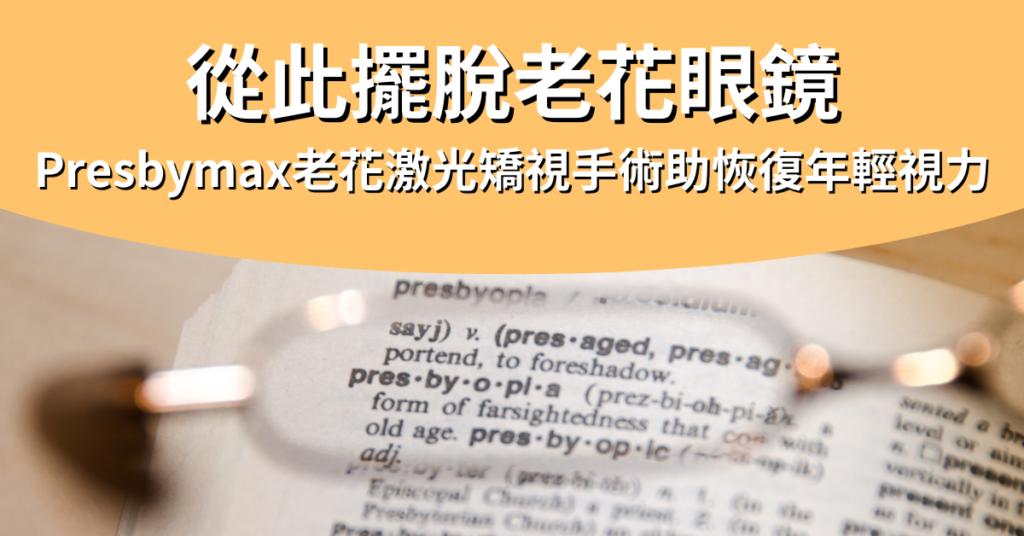
Presbyopia is a vision problem that develops with age, affecting nearly everyone, typically around the age of 40.Many individuals with presbyopia avoid wearing reading glasses out of fear of being perceived as old, which can significantly impact daily life. However, an increasing variety of presbyopia correction methods are now available on the market, making reading glasses no longer the only option. For instance, Presbymax laser surgery for presbyopia, highly recommended by ophthalmologist Dr. Tang Wenjie, not only eliminates the awkwardness of wearing reading glasses but also restores vision to its youthful clarity.
What is presbyopia?
The most common symptom of presbyopia is difficulty reading, where text on phones or books becomes significantly harder to see, requiring constant adjustments in distance to find clearer focus. Prolonged close-up activities often lead to eye fatigue, dryness, or discomfort; when performing close work in dim environments, more light is needed to help the eyes focus.
The primary cause of presbyopia is the degeneration of the lens and ciliary muscles within the eye. This degeneration causes the lens to become rigid and lose elasticity, thereby impairing the eye's refractive ability and ultimately affecting vision.
Although presbyopia typically occurs around age 40, people increasingly rely on electronic devices due to technological advancements. Prolonged screen time causes excessive strain on the ciliary muscles, accelerating the onset of presbyopia. Therefore, protecting eye health is crucial for modern individuals.It is recommended to reduce screen time, allowing the eyes sufficient rest to slow the progression of presbyopia.
2 Ways to Self-Test for Presbyopia
Method One: Symptom Check
Below are some common symptoms associated with presbyopia. If you experience three or more of these, you may have presbyopia.
- When looking at your phone, you need to hold it farther away to see clearly.
- When looking at objects, I find myself wanting to take off my glasses—yet without them, I see more clearly.
- Feeling that your home or office is dimmer than before
- Often misread numbers or text
- I often feel eye strain.
- Stiffness and soreness in the shoulders and neck
- Frequently frowns, experiences dizziness
Method Two: Banknote Test
- Take out a bill and place it where you can see it most clearly.
- Then focus on the fine print on the banknote.
- Look away from the banknote and focus on an object about 2 to 3 meters away for approximately 5 seconds.
- Then look back at that line of small print and see how many seconds it takes to make out the text.
Focusing within 1 second is considered normal; Taking longer than 1 second indicates a risk of developing presbyopia; Taking over 3 seconds confirms the presence of presbyopia.
If you suspect you have presbyopia, it is recommended to consult an ophthalmologist as soon as possible to obtain professional advice and assistance. Based on your visual needs, the ophthalmologist will advise whether you require reading glasses or suggest Presbymax laser surgery to improve presbyopia. Early identification and management of presbyopia can help enhance vision and improve quality of life.
What is the difference between presbyopia and hyperopia?
Presbyopia and hyperopia both cause blurred vision when looking at close objects, but their underlying causes differ. Additionally, if you notice any vision issues, it's advisable to get an eye exam.
- Presbyopia is a degenerative condition of the eye.
Presbyopia is an age-related vision issue. As we grow older, the eye's lens and ciliary muscles gradually deteriorate, weakening the eye's focusing ability. This makes it difficult to see clearly when viewing close objects or in dimly lit environments.If presbyopia significantly impacts daily life, Presbymax presbyopia correction surgery may be considered. This is because Presbymax not only treats presbyopia but also helps improve issues like myopia, hyperopia, and astigmatism, restoring the eyes to a more youthful state.
- Hyperopia is congenital.
Hyperopia is a vision problem related to the structure of the eyeball. It primarily results from a shorter eyeball or weak ciliary muscles. If the eyeball is shorter but the ciliary muscles are strong, visual blurring is generally not an issue; however, when the ciliary muscles become weak, extra effort is required to focus on nearby objects.Hyperopia is congenital, meaning most children exhibit some degree of farsightedness. However, there is no need for excessive concern, as the condition typically improves as the eye develops normally.
Ignoring presbyopia can lead to serious health problems!
Many patients dismiss presbyopia as a minor inconvenience, believing they can simply squint to see clearly and refusing to wear reading glasses.However, this behavior can lead to overworking the ciliary muscles, increasing the burden on the eyes and causing discomfort such as eye strain and soreness. In severe cases, the discomfort may even spread to the shoulder and neck areas, resulting in symptoms like shoulder and neck pain, headaches, dizziness, and nausea.
Presbyopia is not an urgent condition, but its severity increases steadily with age. If diagnosed with 100 diopters of presbyopia at age 40, it will progress to 300 diopters by age 60, with the degree of presbyopia typically increasing by about 10 diopters annually.An abnormal decrease in presbyopia severity may signal a significant warning sign of cataracts. Patients should promptly seek a detailed examination and appropriate correction from an ophthalmologist. Timely identification and management of presbyopia are crucial for safeguarding eye health.
What are the methods for correcting presbyopia?
Medical science continues to advance, and the methods for correcting presbyopia are increasingly diverse. These include wearing single-vision glasses, multifocal glasses, contact lenses, or undergoing surgical procedures such as intraocular lens implantation or Presbymax laser surgery.
- Single-vision glasses: Typically, single-vision glasses are only worn when viewing objects at close range. These glasses provide clear vision only at a specific distance. However, if a person experiences both nearsightedness and presbyopia, they would need to frequently switch between two pairs of glasses with different prescriptions for different situations. In such cases, multifocal glasses may be a suitable option.
- Multifocal glasses: These glasses feature lenses with multiple focal points, allowing you to see clearly at distant, intermediate, and close-up distances with a single pair, eliminating the need for frequent lens changes.
- Multifocal contact lenses: For those who dislike the bulkiness of glasses or already wear contact lenses regularly, multifocal contact lenses or vision correction surgery are viable options.
- Surgical Treatment: Surgical options may include monovision surgery, multifocal intraocular lens implantation, and Presbymax laser vision correction surgery. Presbymax laser vision correction surgery represents a relatively newer alternative. This procedure uses laser technology to reshape the cornea, thereby improving presbyopic vision and reducing or eliminating dependence on eyeglasses or contact lenses.
Traditional Refractive Surgery vs. Presbymax Presbyopia Correction: Which Should You Choose?
| Monocular Vision Surgery | Multifocal Intraocular Lens | Presbymax Presbyopia Correction |
|---|---|---|
| ❌ Blurred mid-range images | ||
| ❌Lacks depth perception | ❌ Glare issues | |
| ❌ Not suitable for night driving | ||
| ❌It takes time to adjust. | ✅ Clear vision at far, intermediate, and near distances | |
| ✅ No glare issues | ||
| ✅ No recovery period required; resume normal activities within 24 hours post-procedure. |
Presbymax presbyopia correction surgery primarily involves laser reshaping of the corneal surface to create a multifocal cornea. The main procedure corrects the dominant eye's myopia, hyperopia, and astigmatism to near zero diopters. The other eye retains or creates approximately 150 to 250 degrees of myopia, specifically for near vision and improving presbyopia.Additionally, Presbymax incorporates mild spherical aberration to enhance binocular depth of field, extend focal range, and modify chromatic aberration. This creates a "fusion zone" between both eyes, enabling patients to achieve clear vision at far, intermediate, and near distances while preserving original color sensitivity and depth perception.
Dr. Tang stated that Presbymax is currently one of the globally recognized and well-established methods for presbyopia correction. Patients who undergo Presbymax presbyopia correction surgery report extremely high satisfaction, and the procedure is relatively affordable. The surgery itself is very brief, taking approximately 10 minutes to complete. Patients can resume normal activities within 24 hours, with vision fully restored within a few weeks and no discomfort whatsoever. This is precisely why Presbymax stands as the optimal choice for presbyopia correction.